Contact us
Send Us Your Case Details
We’ll respond and let you know the best way to proceed with your case.

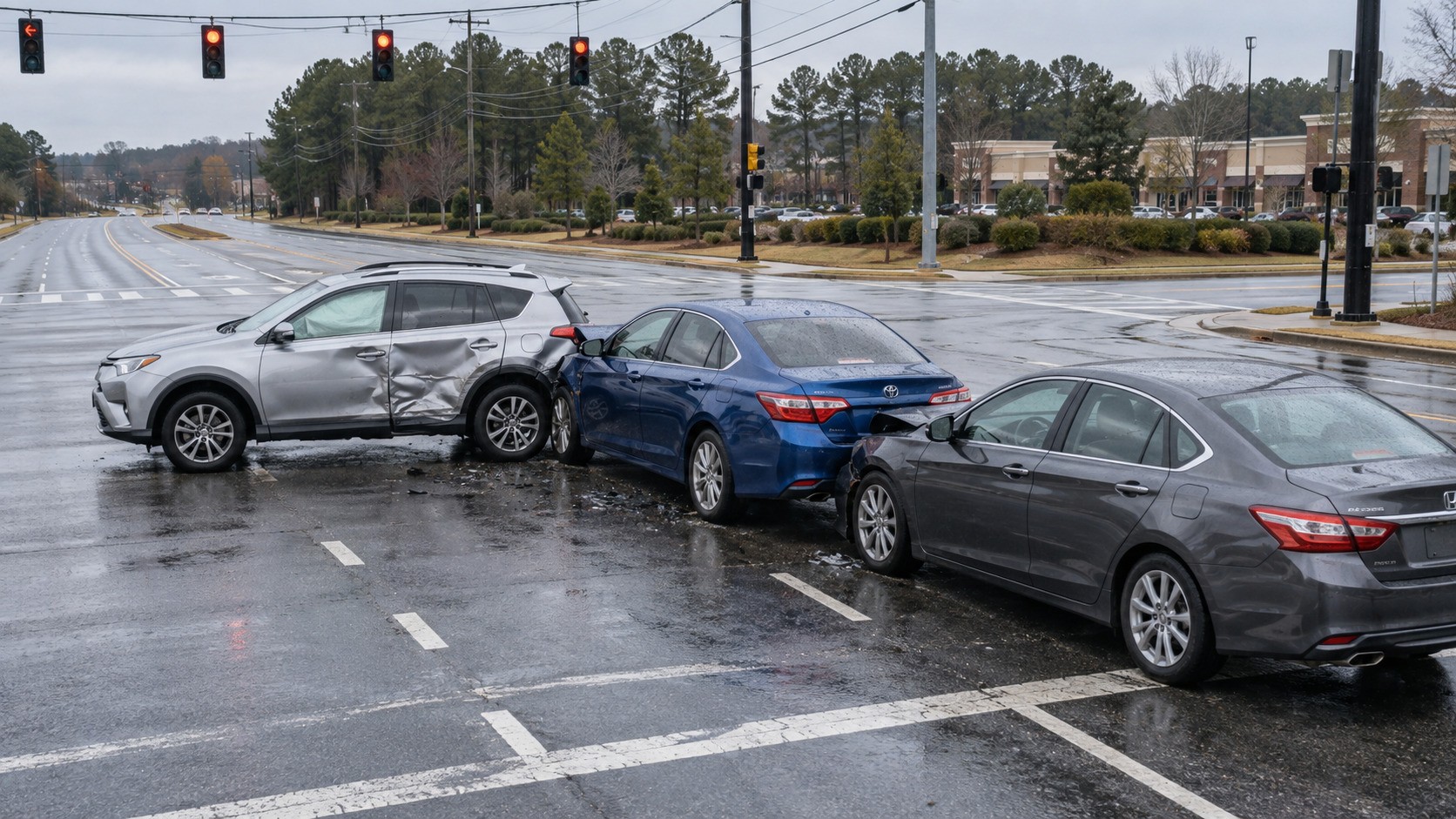
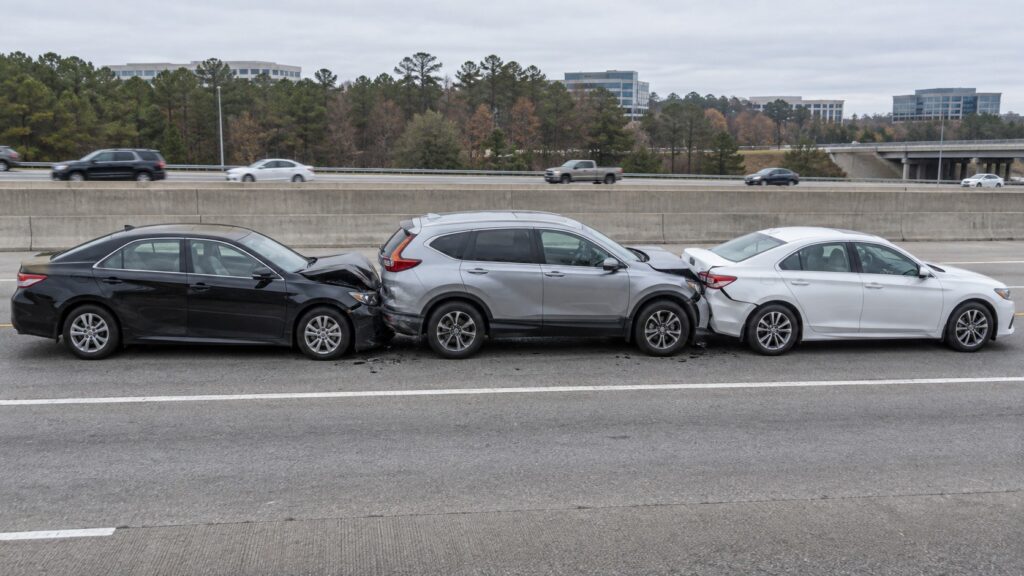
A chain-reaction crash begins with one impact and ends with several. One vehicle strikes another. That vehicle is pushed into a third, and the collision keeps spreading down the line. These pileups happen on Interstate 285, on Georgia 400, and on Interstate 75 through Macon. They also happen on ordinary surface streets during a rainy rush hour, in fog, in construction zones, and behind sudden stops that nobody expected.
The legal aftermath is more complicated than a typical two-car collision. Several drivers may share blame. Multiple insurance companies may be involved, and each one has an incentive to point at someone else. Injured people often wait months just to learn who is going to pay for their medical bills.
This article explains how Georgia law handles multi-vehicle collisions. It covers how fault is determined and how Georgia divides responsibility among several drivers. The article also looks at the insurance picture and the steps you should take if you were caught in one of these crashes.
Georgia does not have a law written specifically for pileups. A chain-reaction crash is analyzed under the same negligence principles that apply to every other collision in the state. The difference is scale. In a two-car crash, an adjuster or jury asks whether one driver was careless. With a pileup, that question must be answered for every driver in the chain.
Negligence in Georgia requires four things. The defendant owed a duty of care. Then the defendant breached that duty. That breach caused harm, and the harm produced real damages. Every driver on a Georgia road owes a duty to drive with ordinary care. That duty includes keeping a safe following distance, paying attention, and adjusting speed for conditions.
Georgia’s Rules of the Road supply many of the specific standards. The most important one in a rear-end pileup is the following-too-closely law, found at O.C.G.A. § 40-6-49. It prohibits following another vehicle more closely than is reasonable and prudent under the circumstances. Speed of traffic and the condition of the highway both factor in. When a driver violates a traffic statute and that violation causes injury, Georgia courts may treat the violation as negligence per se. In practical terms, the injured person no longer needs to prove the conduct was unreasonable. The statute already made that judgment.
Distracted driving is another common cause. Georgia’s Hands-Free Law, found at O.C.G.A. § 40-6-241, prohibits drivers from holding a phone or other wireless device while driving. Phone records and witness accounts frequently become central evidence in these cases. That is especially true when the chain reaction begins with a driver who never touched the brakes.
There is no automatic rule that the last car in line is always at fault. Investigators and lawyers reconstruct the sequence of impacts to figure out who hit whom, in what order, and why. Several scenarios come up again and again.
The rear driver started it. A classic pileup begins when a driver at the back fails to stop and plows into slowed or stopped traffic. The force shoves the car ahead into the next one, and so on. In this scenario, the rear driver often carries most or all of the fault. The middle drivers were stopped or moving properly and were simply pushed.
A middle driver stopped too close. Sometimes the vehicle in the middle had already rear-ended the car ahead before the rear driver arrived. Or a middle driver was tailgating so closely that even a moderate impact from behind forced a collision. Here, fault can be split between the rear driver and one or more middle drivers.
The lead driver caused a sudden stop. A driver at the front who brakes hard for no reason or stops in a travel lane can bear part of the responsibility. Georgia law still expects the drivers behind to leave enough room. For that reason, a sudden stop rarely shifts all the blame forward. It can shift some of it.
Weather, road conditions, or a third party. Fog on Interstate 16, black ice on a bridge, or debris from an unsecured load can start a chain reaction. Weather itself is not a defendant, but Georgia law expects drivers to slow down for conditions. A driver going the posted limit in heavy fog may still be found negligent. In some cases a trucking company, a road maintenance agency, or a vehicle manufacturer may also share fault.
Georgia also recognizes a sudden emergency defense. A driver who is suddenly confronted with an emergency not of their own making is judged differently. The standard becomes what a reasonable person would do in that emergency, not what a calm driver with time to think would do. Whether this defense applies is usually a question for the jury.
Fault in Georgia is not all or nothing. The state uses a modified comparative negligence system, set out in O.C.G.A. § 51-12-33. Two features of that statute matter enormously in a multi-vehicle crash.
First, your own recovery is reduced by your percentage of fault. If your damages total $100,000 and a jury finds you 20 percent responsible, you recover $80,000.
Second, there is a hard cutoff. Under O.C.G.A. § 51-12-33(g), a plaintiff who is found 50 percent or more at fault recovers nothing. A driver found 49 percent responsible still gets slightly more than half of their damages. Someone found exactly 50 percent responsible walks away with zero.
That cutoff is why insurers in pileup cases work so hard to push fault toward the person making a claim. Every percentage point they can shift onto you reduces what they owe. If they can get you to 50 percent, they owe nothing at all.
The other half of O.C.G.A. § 51-12-33 governs how fault is divided among the people who caused the crash. This is where Georgia differs sharply from many other states.
Georgia abolished joint and several liability for most negligence cases in 2005. In a state with joint and several liability, an injured person can collect the entire judgment from any one defendant. That defendant then has to chase the others for reimbursement. Georgia does not work that way. Under O.C.G.A. § 51-12-33(b), the trier of fact assigns a percentage of fault to each person who contributed to the injury. Each defendant is liable only for their own share.
Consider a three-car pileup where the injured driver is in the lead vehicle and bears no fault. The jury assigns 70 percent of the blame to the rear driver and 30 percent to the middle driver. Each of those drivers pays their own percentage of the verdict. If the rear driver has no insurance and no assets, the injured person cannot collect that 70 percent from the middle driver. The shortfall falls on the injured person. That gap is why uninsured and underinsured motorist coverage is so important in Georgia.
Georgia law also allows fault to be assigned to nonparties. Under O.C.G.A. § 51-12-33(c), the jury may consider the fault of people who are not defendants in the lawsuit. That includes someone who settled early, someone who could not be identified, or someone who was never sued. A defendant who wants the jury to consider a nonparty’s fault must give notice at least 120 days before trial under O.C.G.A. § 51-12-33(d). In 2022, the legislature amended the statute to confirm that nonparty apportionment applies even when only one defendant has been sued. That amendment reversed a 2021 Georgia Supreme Court decision that had limited the practice.
For a pileup victim, the takeaway is simple. Fault gets divided among everyone involved. You only collect from each responsible driver what that driver’s share and that driver’s insurance will allow. Identifying every potentially responsible party early is essential.
Georgia is an at-fault state. It does not have a no-fault system, and it does not require personal injury protection coverage. The driver who caused the harm, and that driver’s liability insurer, are responsible for paying. In a pileup, that principle plays out across several policies at once.
Minimum liability limits. Georgia requires every motorist to carry at least $25,000 in bodily injury coverage per person and $50,000 per accident. Property damage coverage must be at least $25,000. These figures come from O.C.G.A. § 33-7-11. A chain-reaction crash can exhaust those limits almost immediately. Suppose a driver with a minimum policy causes a five-car pileup that injures six people. The entire $50,000 per-accident limit must be shared among all six, no matter how serious their injuries.
Uninsured and underinsured motorist coverage. Georgia insurers must offer uninsured motorist coverage, and the policyholder can only decline it in writing. This coverage steps in when the at-fault driver has no insurance or not enough of it. Georgia offers two forms. Added-on coverage stacks your UM limits on top of what the at-fault driver’s insurer pays. Reduced-by coverage subtracts the at-fault driver’s payment from your UM limits first. The difference can be tens of thousands of dollars. It is worth checking which form your own policy contains.
Medical payments coverage. MedPay is optional in Georgia. If you carry it, it pays your medical bills regardless of fault, up to the policy limit. It can be a lifeline in the months before liability is sorted out.
Multiple adjusters, multiple agendas. In a four-car crash, four liability carriers may be investigating. Each one wants to minimize its own insured’s share of the blame. Adjusters may contact you early and ask for a recorded statement. Anything you say about speed, following distance, or what you saw can be used to shift fault your way. You are generally not required to give a recorded statement to another driver’s insurer. It is wise to speak with a lawyer before doing so.
Your obligations at the scene of a crash are set by statute. Under O.C.G.A. § 40-6-270, a driver involved in a collision that results in injury, death, or vehicle damage must stop. That driver must also render reasonable assistance and exchange name, address, and registration information. Leaving the scene of an injury crash is a serious offense.
Under O.C.G.A. § 40-6-273, drivers must report a crash to local police, the sheriff, or the Georgia State Patrol in certain situations. The duty applies when the crash results in injury, death, or apparent property damage of $500 or more. Nearly every multi-vehicle collision meets that threshold. Georgia law under O.C.G.A. § 40-6-275 also directs drivers of vehicles that are still drivable to move them out of the travel lanes when there are no serious injuries. The goal is to let traffic pass safely.
Beyond those legal duties, a few practical steps protect your health and your claim:
Because so much depends on the sequence of impacts, evidence is the whole ballgame in a Georgia pileup claim.
The crash report. Georgia’s Uniform Motor Vehicle Accident Report is prepared by the responding officer. It will typically list every vehicle, diagram the scene, and note any citations. Many Georgia agencies make reports available through online portals such as BuyCrash. The report can also be requested directly from the agency. An officer’s opinion about fault is not binding, but it carries weight with adjusters.
Vehicle damage patterns. The location and depth of damage on each car helps reconstruct the order of collisions. A car with light damage in front and heavy damage behind tells a different story than one with the reverse.
Event data recorders. Most modern vehicles contain a module that records speed, braking, throttle position, and seat belt status before a crash. This data can be decisive in showing whether a driver braked at all. It can be overwritten or lost when a vehicle is repaired or scrapped. Preservation letters should go out quickly.
Video. Dashcams, commercial vehicle cameras, nearby business surveillance systems, and Georgia Department of Transportation traffic cameras may have captured the crash. Much of this footage is deleted within days.
Phone records. If distraction is suspected, cell phone records can show whether a driver was texting or on a call at the moment of impact.
Accident reconstruction. In serious pileups, both sides often retain engineers. These experts use physics, vehicle data, and scene measurements to model the sequence of events.
For decades, Georgia law prohibited defendants from telling a jury that an injured person was not wearing a seat belt. That changed in 2025. Senate Bill 68 was signed on April 21, 2025, and amended O.C.G.A. § 40-8-76.1. Failure to wear a seat belt may now be considered on the issues of negligence, comparative negligence, causation, assumption of risk, and apportionment of fault. It may also be used to reduce damages. Courts retain the ability to exclude the evidence if its prejudicial effect substantially outweighs its value.
Seat belt use can become a major point of dispute in a chain-reaction crash. A vehicle may be struck multiple times from different directions. Defendants may argue that part of an injury came from the lack of restraint rather than the collision itself.
The same legislation made other changes to Georgia injury litigation. It created new rules on how medical expenses are presented to a jury. Defendants also gained an option to request separate trial phases for liability and damages. Some of these provisions apply only to causes of action arising on or after the effective date. The timing of your crash can therefore affect which rules govern your case.
Georgia’s statute of limitations for personal injury claims is two years from the date of the crash, under O.C.G.A. § 9-3-33. Claims for damage to your vehicle or other property generally carry a four-year limit under O.C.G.A. § 9-3-31.
Shorter deadlines apply when a government entity may be responsible. A claim against a Georgia city requires written notice within six months under O.C.G.A. § 36-33-5. Counties require notice within 12 months under O.C.G.A. § 36-11-1. Claims against the state or a state agency fall under the Georgia Tort Claims Act, which requires written notice within 12 months under O.C.G.A. § 50-21-26. Missing these notice requirements can end a claim before it starts. That is true even if the two-year limitations period has not run.
Two years sounds like plenty of time. In a multi-vehicle case it is not. Identifying every responsible party takes time. So does preserving vehicle data, obtaining video before it is erased, and completing medical treatment. Waiting until the deadline is near leaves little room to build the case properly.
A person injured in a Georgia chain-reaction crash may pursue the same categories of damages available in any injury case. These include past and future medical expenses, lost wages, and diminished earning capacity. Property damage is recoverable. So are noneconomic damages for pain, suffering, and loss of enjoyment of life.
Punitive damages are a separate category. If a driver’s conduct showed willful misconduct or a conscious indifference to consequences, they may be available under O.C.G.A. § 51-12-5.1. That statute caps punitive damages at $250,000 in most cases. The cap does not apply when the defendant acted with specific intent to harm or was under the influence of alcohol or drugs.
In wrongful death cases, Georgia measures damages by the full value of the life of the deceased. The estate may also bring a separate claim for medical and funeral expenses and for the pain the person experienced before death.
The legal principles above apply to every crash in Georgia. What makes a chain-reaction case difficult is the number of moving parts. Consider how the pieces interact.
Several drivers may share fault, so each one’s insurer will try to shift blame to the others and to you. Georgia’s 50 percent bar means that if the finger-pointing pushes your share to half, you recover nothing. The apportionment statute limits what you can collect from each defendant to that defendant’s share and policy limits. One uninsured driver in the chain can leave a large gap. Minimum policy limits get divided among everyone injured, so early claims can drain a policy before you file. Nonparty apportionment means a driver who settled with you early can still be assigned fault at trial. That reduces what the remaining defendants owe.
None of this means an injured person cannot recover fairly. It means that the details matter more than they would in a simple two-car crash. The order in which claims are made, the evidence that is preserved, and the way statements are given to adjusters all affect the result. So does the coverage available under your own policy.
Get medical care first and follow through with treatment. Report the crash and obtain the report. Notify your own insurer promptly, because most policies require it, but stick to the basic facts. Decline recorded statements to other drivers’ insurers until you have advice. Preserve everything, including your vehicle, until the evidence has been documented. Keep a file of medical records, bills, missed work, and photographs.
Then talk to a lawyer who handles Georgia motor vehicle cases. A multi-vehicle crash is one of the situations where early legal help changes outcomes. Preservation letters need to go out before data is lost. Every policy that might apply, including your own uninsured motorist coverage, needs to be identified. The sequence of impacts needs to be reconstructed before memories fade and vehicles are repaired.
Chain-reaction crashes are chaotic in the moment and complicated afterward. Understanding how Georgia assigns and divides fault is the first step toward protecting yourself.
Disclaimer: This article is provided for general informational purposes only and does not constitute legal advice. Laws change, and the application of any law depends on the specific facts of your situation. Nothing in this article creates an attorney-client relationship. If you have been involved in a chain-reaction or multi-vehicle collision in Georgia, always consult with a licensed Georgia personal injury lawyer about your specific circumstances before making any decisions about your claim.