Contact us
Send Us Your Case Details
We’ll respond and let you know the best way to proceed with your case.

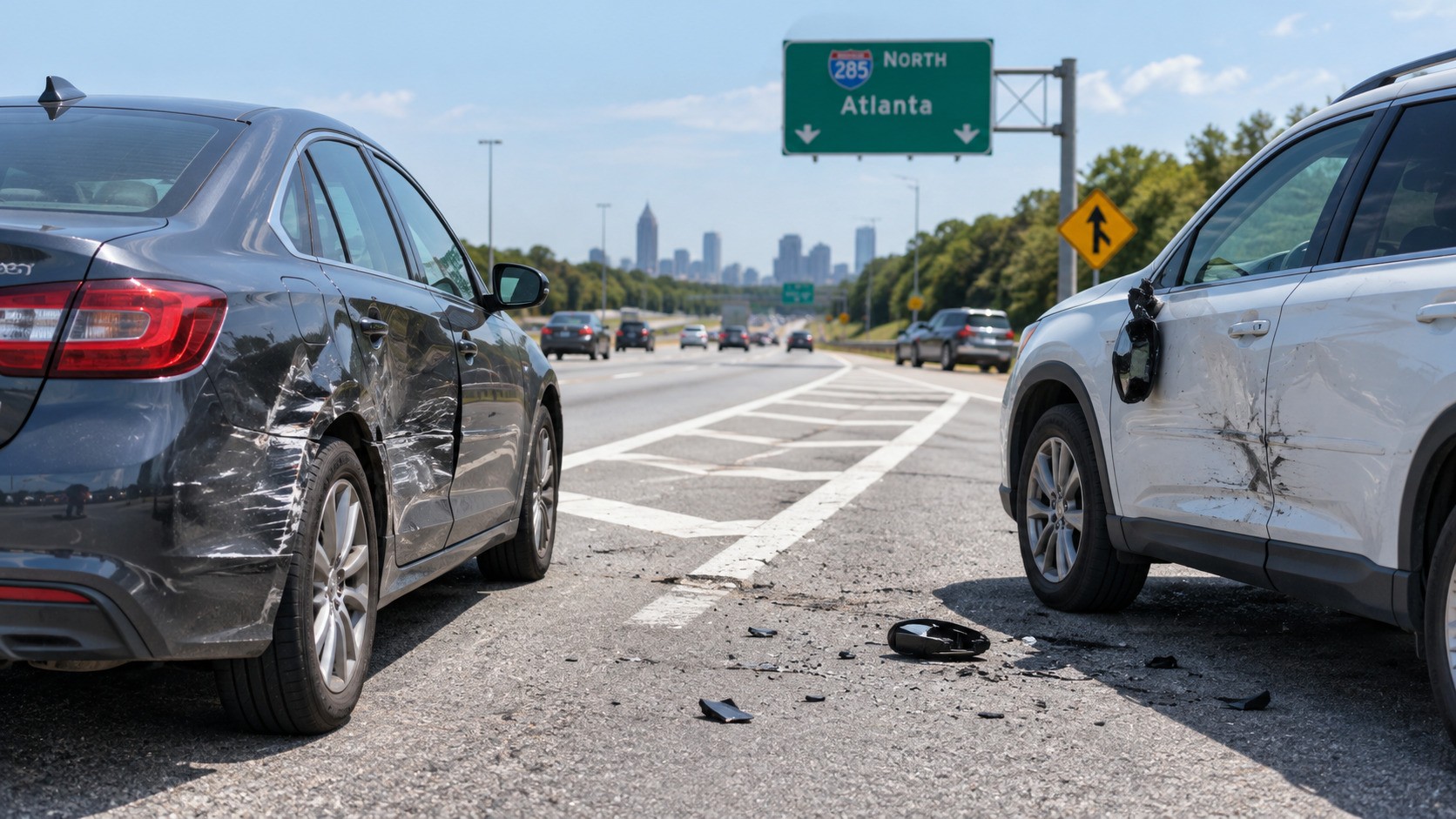
Two cars collide at an intersection in Gwinnett County. Both drivers step out shaken but unhurt enough to argue. One says the light was green. The other insists it was yellow and the first driver ran it. Neither is lying on purpose, but they cannot both be right.
This scene plays out on Georgia roads every day. When the stories conflict, the question of who pays does not simply disappear. Insurance companies, and sometimes a jury, will sort it out using rules that Georgia has written into its statutes. Understanding those rules before you make a phone call or sign a document can protect your claim.
This article explains how Georgia handles a crash where both drivers point at each other. It covers the comparative fault law, the evidence that settles disputes, and the deadlines that apply. Along the way, it flags mistakes that can quietly sink a solid claim.
Some states use a no-fault system. There, each driver’s own insurer pays medical bills regardless of who caused the wreck. Georgia does not work that way. It is an at-fault state. The driver who caused the collision, along with that driver’s liability insurer, pays for the resulting damage.
Because of this, assigning fault is not a formality. It decides who pays for repairs, the emergency room visit, and the missed paychecks. When both drivers deny responsibility, the entire claim stalls until someone determines what actually happened.
Every driver in Georgia must carry minimum liability coverage under O.C.G.A. § 33-7-11. The minimums are $25,000 for bodily injury per person, $50,000 per accident, and $25,000 for property damage. Those numbers set the ceiling on what the other driver’s policy will pay. That ceiling holds even if fault is eventually assigned entirely to that driver.
Georgia’s answer to shared blame is found in O.C.G.A. § 51-12-33. The statute establishes what lawyers call modified comparative negligence. Under this rule, a jury or an adjuster assigns a percentage of fault to each person involved. The percentages must add up to 100.
Your recovery is then reduced by your own share of fault. Say you suffered $40,000 in damages and were found 20 percent responsible. You could recover $32,000 from the other driver. The math is simple once the percentages are set.
There is a hard cutoff. Georgia bars any recovery for a plaintiff who is 50 percent or more at fault. A driver found 49 percent responsible can still collect a reduced amount. One found 50 percent responsible collects nothing from the other side. This single percentage point is often the entire battleground in a case where both drivers blame each other.
Some states use a more generous 51 percent bar, and you may see that number repeated online. It does not apply in Georgia. The statute is explicit that a plaintiff who is 50 percent or more responsible is barred.
Fault can also be assigned to people who are not part of the lawsuit at all. Section 51-12-33(c) allows a jury to consider the fault of nonparties. Examples include a third driver who fled the scene or a contractor who left debris in the road. This means the two drivers arguing at the intersection are not always the only names on the ledger.
No single official declares fault in a Georgia car accident. Instead, several parties weigh in at different stages.
The responding officer is usually the first. Georgia law enforcement uses a standardized crash report. It records the officer’s observations, driver statements, witness information, road conditions, and any citations issued. The report includes a section for contributing factors, such as following too closely or failure to yield.
That report carries real weight with insurance adjusters, but it is not the final word. Officers often arrive after the vehicles have been moved. They rarely witness the crash itself. In court, the officer’s opinion about who caused the wreck is generally not admissible as proof of fault. The officer can still testify about what was observed at the scene.
Insurance adjusters make the next determination. Each driver’s insurer will investigate, and each will reach its own conclusion about fault percentages. Those conclusions frequently disagree. That is exactly what happens when both drivers tell their own company a different story.
If the insurers cannot agree and no settlement is reached, the case may go to a jury. The jury listens to the evidence and assigns the percentages. That decision is binding, subject to appeal.
When two drivers contradict each other, the outcome usually turns on evidence that does not depend on anyone’s memory. The following categories tend to matter most.
Physical evidence at the scene. Skid marks, debris fields, vehicle resting positions, and the damage on each car all tell a story. A reconstruction expert can use it to estimate speed, impact angle, and which vehicle entered the intersection first.
Video footage. Dash cameras are legal in Georgia and are increasingly common. Traffic cameras, business security cameras, doorbell cameras, and bystander cell phone videos can also capture the moment of impact. Footage from a nearby gas station has settled more disputed intersection crashes than most people realize. This evidence is often overwritten within days, so requesting it quickly is essential.
Independent witnesses. A passenger in your own car has an obvious interest in your version. Someone on the corner or a driver two cars back does not. Adjusters and juries give significant weight to neutral witnesses. That is why collecting names and phone numbers at the scene matters so much.
Vehicle data. Most modern vehicles contain an event data recorder, sometimes called a black box. It can store speed, braking, throttle position, and seat belt status for the seconds before a crash. Retrieving this data usually requires a specialist. A court order may be needed if the vehicle belongs to the other driver.
Phone records. Georgia’s Hands-Free Law, codified at O.C.G.A. § 40-6-241, prohibits holding a phone while driving. If one driver was texting at the moment of impact, cell phone records can prove it. Obtaining those records for the other driver generally requires a subpoena. This is one reason disputed cases often involve attorneys.
Medical records. The timing and nature of injuries can corroborate or undermine a driver’s account. A neck injury consistent with a rear impact supports a claim that the other car struck from behind.
Once you report the crash, your insurer and the other driver’s insurer will each open a file. An adjuster will call you, usually within a day or two, and ask for a recorded statement.
You are not required to give a recorded statement to the other driver’s insurance company. Your own policy likely requires you to cooperate with your own insurer. Even then, you can ask to have an attorney present or to provide the statement in writing. Adjusters are trained to ask questions in ways that elicit admissions. An offhand comment like “I guess I was going a little fast” can become the basis for a 30 percent fault assignment.
Georgia’s Unfair Claims Settlement Practices Act, O.C.G.A. § 33-6-34, requires insurers to investigate reasonably before denying a claim. In practice, a disputed-liability claim can drag on for months while each company gathers evidence. Adjusters sometimes propose a 50/50 split simply because it is the path of least resistance. That split is devastating under Georgia law, because a driver assigned exactly 50 percent recovers nothing.
If the other driver’s insurer denies your claim outright, you still have options. You can pursue the claim through your own collision coverage, if you carry it. Your insurer can then seek reimbursement from the other company through a process called subrogation. Alternatively, you can file suit and let a jury decide.
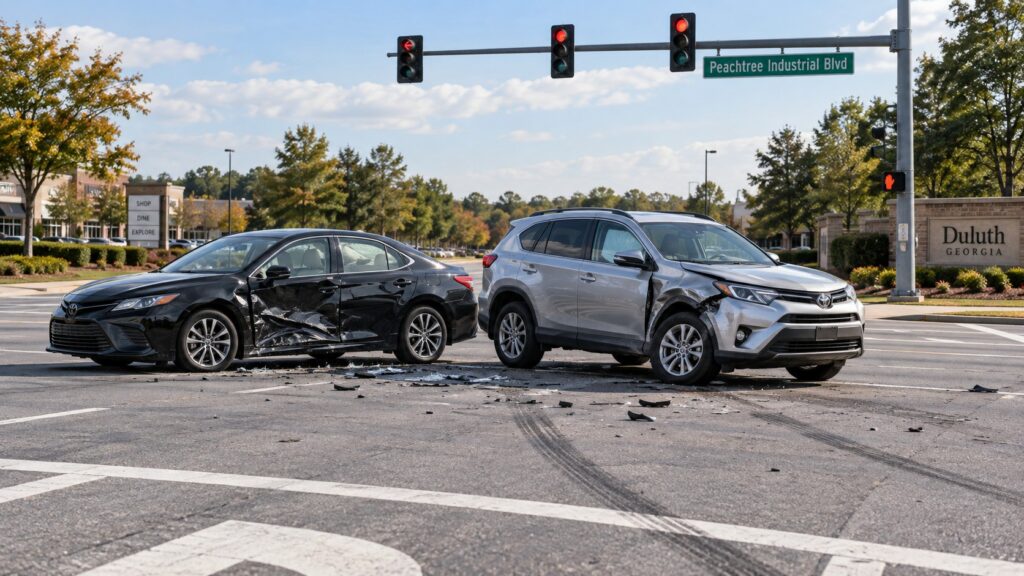
Many disputed crashes fall into familiar patterns, and Georgia’s traffic code addresses most of them directly. A citation for one of these violations is not automatic proof of fault in a civil case. It is still powerful evidence.
Rear-end collisions. O.C.G.A. § 40-6-49 requires drivers to maintain a safe following distance. When one car strikes another from behind, the trailing driver is usually found primarily at fault. That presumption is not absolute. If the lead driver stopped suddenly for no reason, reversed unexpectedly, or had nonfunctioning brake lights, fault can shift.
Left turns. O.C.G.A. § 40-6-71 requires a driver turning left to yield to oncoming traffic close enough to pose a hazard. A driver who turns left into the path of an oncoming car will typically bear most of the fault. The oncoming driver’s speed can still shift a portion of the blame if it was excessive.
Stop signs and yield signs. O.C.G.A. § 40-6-72 governs these intersections. The driver who fails to stop or yield is generally responsible. Disputes arise when both drivers claim they arrived first.
Traffic signals. O.C.G.A. § 40-6-21 sets the rules for red, yellow, and green lights. Signal disputes are among the hardest to resolve without video, because each driver sincerely believes the light favored them.
Lane changes. O.C.G.A. § 40-6-48 requires drivers to stay within a lane and leave it only when safe. Sideswipe crashes frequently involve both drivers claiming the other drifted.
Speeding. Even when the other driver committed the primary violation, your own speed matters. Evidence that you exceeded the limit under O.C.G.A. § 40-6-181 can add to your share of fault.
For decades, Georgia law prohibited a defendant from bringing up whether an injured driver was wearing a seat belt. That rule, found in O.C.G.A. § 40-8-76.1, shielded unbelted drivers from having their damages reduced on that basis.
Senate Bill 68, signed by Governor Brian Kemp on April 21, 2025, eliminated that protection. Evidence of seat belt nonuse is now admissible on questions of negligence, comparative negligence, causation, and apportionment of fault. A defendant can argue that your injuries would have been less severe with a belt on. Juries can then reduce your award accordingly.
Courts retain discretion to exclude this evidence if its prejudicial effect substantially outweighs its value. The law also continues to prohibit insurers from canceling coverage or raising rates based on seat belt nonuse. Still, when fault is already contested, seat belt evidence hands the other side one more argument to push you past the 50 percent line.
The same bill introduced other changes that affect disputed cases. It allows either party to request a bifurcated trial, where the jury decides fault first and damages second. The bill also limits recoverable medical expenses to amounts actually paid or owed rather than amounts initially billed. That provision applies to causes of action arising on or after the effective date.
When liability is stuck in a stalemate, your own policy can keep you from waiting months. It can cover a repair or a medical bill now.
Collision coverage pays to repair your vehicle regardless of fault, minus your deductible. Your insurer will then attempt to recover its payment, and often your deductible, from the other driver’s company. If the other company ultimately accepts partial fault, you may get a portion of the deductible back.
Medical payments coverage, sometimes called MedPay, is optional in Georgia. It pays medical expenses for you and your passengers regardless of fault, up to the policy limit. MedPay is inexpensive and worth having precisely because of disputed-liability situations.
Uninsured and underinsured motorist coverage is not required in Georgia. Insurers must offer it, and you must reject it in writing if you do not want it. This coverage becomes essential when the other driver has no insurance or too little of it. Georgia lets you choose between two forms. “Add-on” coverage stacks on top of the other driver’s limits. “Reduced by” coverage is offset by whatever the other driver’s policy pays. The add-on option costs more but provides substantially more protection.
Georgia imposes strict time limits, and a disputed claim does not pause the clock.
Under O.C.G.A. § 9-3-33, you have two years from the crash date to file a personal injury lawsuit. Claims for property damage to your vehicle carry a four-year limit under O.C.G.A. § 9-3-31. If the claim involves a government vehicle or employee, additional notice requirements apply. Those deadlines can be much shorter.
The statute of limitations governs when a lawsuit must be filed, not when an insurance claim must be submitted. Most policies require prompt notice of a crash. Waiting weeks to report it can give the insurer grounds to question the claim.
Separately, O.C.G.A. § 40-6-273 requires drivers to report certain crashes to law enforcement. The duty applies to any crash involving injury, death, or apparent property damage of $500 or more. In practice, nearly every collision meets the $500 threshold. Calling the police also produces the crash report that becomes the foundation of the insurance investigation.
Certain actions at the scene and afterward can shift fault percentages against you. This can happen even when you did nothing wrong on the road.
Apologizing is the most common. Saying “I’m sorry” is a natural reflex. The other driver and any witnesses will remember it, and an adjuster will treat it as an admission. You can check on the other driver’s well-being without discussing who caused the crash.
Posting about the crash on social media is another. Insurers routinely review public profiles. A photo of you at a concert the weekend after claiming a back injury will be used against you. How you actually felt that night will not matter.
Skipping medical care creates problems too. Wait a week to see a doctor, and the other side will argue your injuries came from something else. Prompt treatment creates a record that ties your injuries to the crash.
Signing a release before you know the full extent of your injuries can end your claim for good. Once you sign, you generally cannot reopen the matter, even if a more serious injury surfaces later.
Giving a recorded statement to the other driver’s insurer without preparation is the last of the big ones. You have no obligation to do so, and a politely declined request costs you nothing.
The steps below give you the best chance of prevailing when the other driver disputes fault.
If negotiations fail, a lawsuit is the mechanism for forcing a decision. Such cases are typically filed in the superior or state court of the defendant’s home county.
The discovery phase allows each side to obtain evidence the other side controls. This is where phone records, event data recorder downloads, and internal insurance notes come into play. Depositions of both drivers, under oath, often expose inconsistencies in the version that one driver has been telling.
At trial, the jury hears from both drivers, witnesses, the responding officer, and experts such as accident reconstructionists. The jury is then instructed on Georgia’s comparative fault rule and asked to assign percentages. If the plaintiff is found 50 percent or more at fault, the case ends with no recovery.
Georgia does not cap compensatory damages in car accident cases. Punitive damages are generally capped at $250,000 under O.C.G.A. § 51-12-5.1. That cap does not apply when the defendant was driving under the influence of alcohol or drugs.
Most cases settle before reaching a jury. Even so, a credible willingness to go to trial often moves an insurer off a 50/50 position.
Consider a crash on Pleasant Hill Road in Duluth. Driver A is making a left turn on a solid green light. Meanwhile, Driver B approaches from the opposite direction. They collide in the intersection.
Driver A says Driver B was speeding and ran a red light. According to Driver B, the light was green and Driver A turned directly into oncoming traffic. The officer arrives after both cars have been pushed to the shoulder and issues no citation.
Without more, an adjuster might lean toward Driver A being primarily at fault. Georgia law, after all, requires a left-turning driver to yield. Driver A’s insurer proposes 70/30 against its own insured. Then Driver A’s attorney obtains footage from a pharmacy camera. It shows Driver B entering the intersection nearly two seconds after the light turned red. Suddenly the allocation flips. Driver B’s failure to obey the signal becomes the primary cause. Meanwhile, Driver A’s share of fault drops well below 50 percent.
The facts did not change. Only the evidence did. That is the reality of a Georgia crash where both drivers blame each other.
A disputed-liability car accident in Georgia is decided by evidence, not by who argues more forcefully. The state’s modified comparative negligence rule gives you a path to recovery as long as you stay below the 50 percent threshold. That single percentage point can be worth tens of thousands of dollars.
Protect your position by calling the police, documenting the scene, and seeking medical care. Decline to give statements to the other driver’s insurer until you understand your rights. Act quickly. Video evidence disappears, and the two-year filing window does not wait for insurers to finish arguing.
This article provides general information about Georgia law and is not legal advice. Every case depends on its own facts. If fault in your crash is contested, consult a licensed Georgia attorney about your specific situation.