Contact us
Send Us Your Case Details
We’ll respond and let you know the best way to proceed with your case.

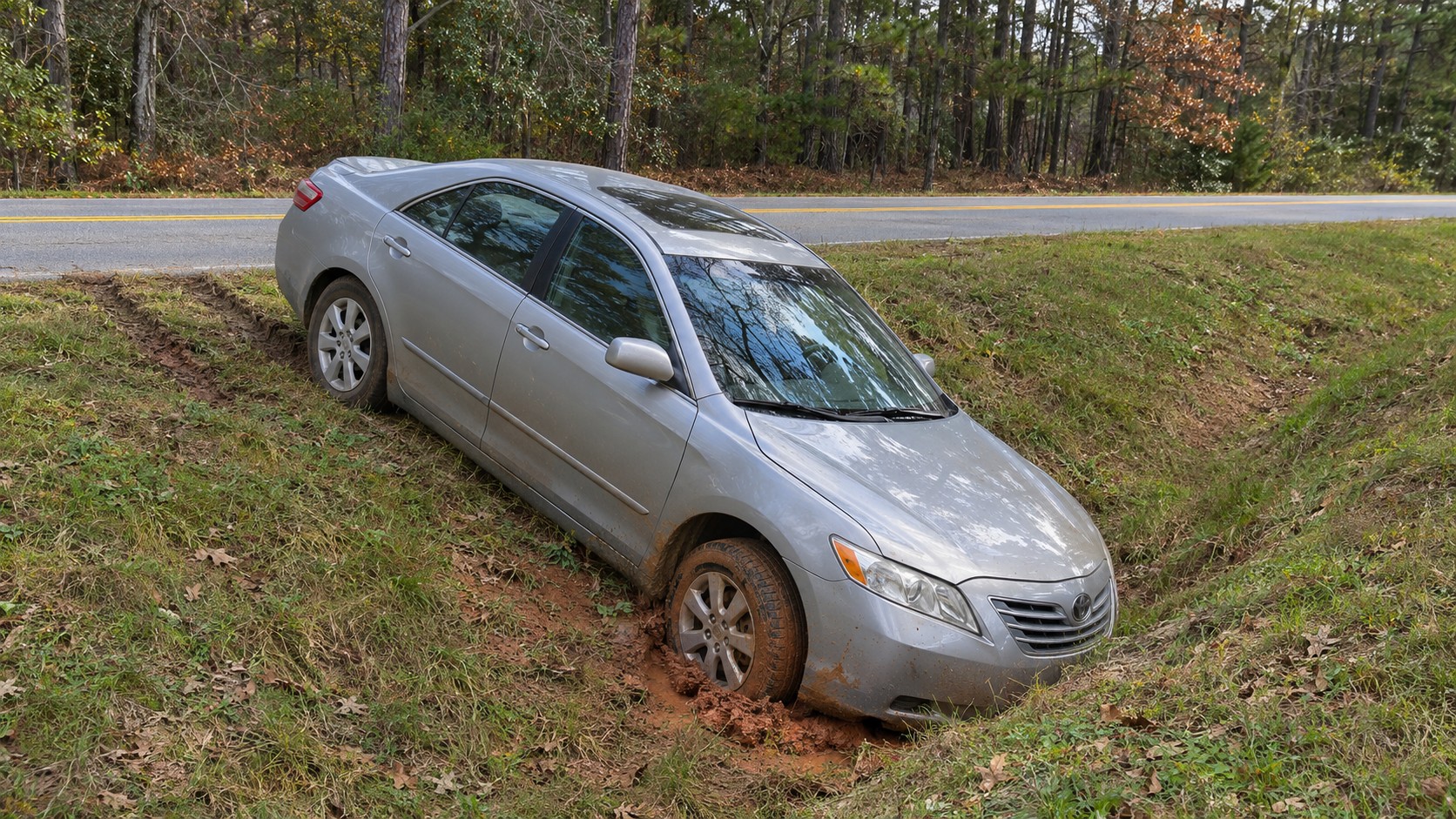
You are driving down a two-lane road in Gwinnett County or merging onto I-285 when another driver suddenly swerves into your lane. You jerk the wheel to avoid a collision, and the next thing you know your car is in a ditch, wrapped around a guardrail, or sitting in the median with the airbags deployed. The other driver never touched you. In many cases, they never even slowed down.
People in this situation often walk away believing they have no claim. There was no impact between the two vehicles, the other driver is gone, and the only damage is to your car and your body. It feels like a single-car accident, and that is exactly how some insurance companies would like you to see it.
Georgia law does not see it that way. A driver who causes a crash is responsible for it whether or not their bumper ever touches yours. What changes in a no-contact crash is not whether you can recover, but how you prove what happened and which insurance policy ends up paying. This guide walks through how these cases work in Georgia, the rules that can make or break your claim, and what you should do as soon as possible after the crash.
The foundation of any car accident claim in Georgia is negligence. Every driver has a duty to use ordinary care on the road. That means staying in their lane, yielding when required, checking blind spots, obeying traffic signals, and not driving aggressively. If a driver breaks that duty and it causes you harm, they can be held responsible for the harm.
Nothing in that principle depends on the two cars touching. If a driver drifts across the center line and you swerve to avoid a head-on collision, their negligence caused your crash just as surely as if they had hit you. The same is true when someone merges into your lane without looking, pulls out from a side street directly in front of you, or cuts you off so sharply that braking or swerving is the only option.
Georgia also recognizes what is often called the sudden emergency doctrine. When a driver is suddenly confronted with a dangerous situation they did not create, the law does not expect them to make a perfect decision in a split second. If you swerved and ended up hitting a tree, a mailbox, or another vehicle, the question is whether your reaction was reasonable under the circumstances, not whether some other choice might have worked out better in hindsight. That matters, because insurers in these cases frequently argue that the injured driver simply overreacted or lost control on their own.
So the short answer is yes. If another driver ran you off the road, you can pursue a claim against that driver even though there was no contact. The real challenge is practical: identifying who was at fault, proving the other vehicle existed, and figuring out which insurance applies.
The easier version of this situation is when you can identify the other driver. Sometimes they stop. Sometimes a witness writes down the license plate. Sometimes the driver is a delivery van, a company truck, or a city bus with a name on the side.
When the driver is known, the claim works much like any other Georgia car accident claim. Georgia is an at-fault state, so the at-fault driver’s liability insurance is responsible for your injuries and property damage. Georgia requires drivers to carry at least $25,000 in bodily injury coverage per person, $50,000 per accident, and $25,000 in property damage coverage. If your injuries are worth more than the other driver’s limits, your own underinsured motorist coverage may help make up the difference.
Expect the other driver’s insurer to push back harder than usual. Without a dent on your car from their client’s vehicle, the adjuster may argue that their driver did nothing wrong, that your car left the road for some other reason, or that you were speeding or distracted. This is where witness statements, video footage, and a clear police report become critical, which we will come back to below.
If the driver was working at the time, such as a commercial truck driver or a delivery driver, their employer and the employer’s insurance policy may also be involved. Commercial policies often carry much higher limits than personal auto policies. If the vehicle belonged to a city, county, or state agency, Georgia imposes special written notice requirements with much shorter deadlines, discussed later in this article.
The harder and far more common situation is when the other driver keeps going. Lawyers and insurers often call this a “phantom vehicle” case. The driver caused the crash, but nobody knows who they are, and there is no liability insurer to file a claim against.
In that situation, the coverage that usually matters most is your own uninsured motorist coverage, often called UM coverage. Under Georgia law, a vehicle is treated as uninsured when its owner or driver is unknown. That means your UM coverage can step into the shoes of the unidentified driver and pay for injuries the phantom driver caused.
Georgia insurers are required to offer UM coverage with every auto policy, and you have it unless you rejected it in writing. Many people carry it without realizing it. Before you assume you have no options, pull out your policy’s declarations page or call your agent and ask exactly what UM limits you have and whether your UM coverage is written to add on top of another driver’s coverage or to be reduced by it.
UM coverage in Georgia can also apply to property damage, typically with a deductible. If you have collision coverage, that coverage can usually pay to repair your car regardless of who caused the crash, subject to your collision deductible. Which of these makes more sense to use for your vehicle depends on your specific policy, and it is worth asking your agent to walk you through both options.
Here is the part of Georgia law that catches many people off guard, and it is the single biggest reason no-contact claims get denied.
When an unknown driver causes a crash without physically touching your vehicle, Georgia’s uninsured motorist statute does not let you recover on your word alone. Your account of how the crash happened has to be corroborated by an eyewitness to the crash who is someone other than you. If there was physical contact between the phantom vehicle and you or your car, the rules are different. But in a true no-contact case, eyewitness corroboration is the key that unlocks your UM coverage.
The purpose of the rule is to prevent fraud. Without it, any driver who lost control on their own could invent a mystery car to get paid. The legislature decided that an independent eyewitness was the way to separate real phantom vehicle claims from made-up ones.
Georgia courts have explained that the eyewitness does not have to confirm every single detail of your story. What the eyewitness needs to corroborate is the core of it: that another vehicle existed and that it caused the crash. A driver behind you who saw a pickup cross into your lane and force you off the road is the kind of witness the law has in mind. On the other hand, courts have rejected witnesses who only arrived after the crash and saw the aftermath, because they did not actually see the occurrence. Someone who heard the screech of tires and then saw your car in a ditch may not be enough.
Whether a particular person qualifies can become a point of dispute. Other drivers, pedestrians, and people working nearby are the most straightforward eyewitnesses. A passenger in your own car may be able to serve as a witness in some situations, but insurers sometimes challenge passengers, especially if they are also making a claim. Video footage from a dashcam or a nearby business can be extremely helpful evidence and may even lead to identifying the driver, but you should not assume that video alone will satisfy the statute’s eyewitness requirement in every case. The safest course is to find and preserve every possible human witness as well as every possible video.
This is why the minutes right after a no-contact crash matter so much. The witnesses who saw what happened are often strangers who pull over for a moment, see that you are alive, and leave. If you do not get their names and phone numbers, they may be gone forever, and your claim may go with them.
Your safety comes first. If you are hurt, stay put and call 911. If you can move safely, get yourself and your passengers out of traffic. Once you are safe, the steps below can protect your claim.
Call the police, even if you think the damage is minor. Georgia law requires drivers to report any crash that causes injury, death, or apparent property damage of $500 or more, and that requirement applies to a single-vehicle crash as well. A police report also does something especially important in a phantom vehicle case. It creates an official record, made right away, that you reported another driver forced you off the road. Tell the officer clearly that another vehicle caused the crash, describe it as specifically as you can, and make sure the officer has the names and contact information of anyone who saw it. Later, ask for a copy of the report and check that it reflects what you told the officer.
Talk to anyone who stopped. Ask them directly what they saw, and get their full name, phone number, and email address. If someone is willing, ask them to send you a quick text describing what they saw, or record a short video of them explaining it on your phone. A witness who saw the other vehicle cross into your lane is worth more to your claim than almost anything else you can collect.
Write down everything you remember about the other vehicle as soon as you can. Color, make, model, body style, whether it was a car, SUV, or truck, any damage, stickers, company logos, partial plate numbers, and which way it went. Memory fades quickly after a traumatic event, and small details can help police or an investigator track the driver down later.
Take photos and video of the scene. Capture your car’s final resting place, skid marks or tire tracks in the grass, the lane markings, the road layout, any traffic signs or signals, and the weather and lighting. Skid marks that show a hard swerve can support your account that you were reacting to something. Photograph any damage to your car and anything you struck.
Look for cameras. Gas stations, stores, apartment complexes, homes with doorbell cameras, and traffic cameras may have recorded the other vehicle. Many systems automatically record over footage within days, so this is time sensitive. Ask business managers to save the footage, and tell the investigating officer about any cameras you see. If you have a dashcam, save that footage immediately and back it up.
Get medical care right away. Adrenaline can mask injuries, and some of the most common crash injuries, like neck and back injuries and concussions, may not show up fully for a day or two. Going to the ER, urgent care, or your doctor promptly protects your health and creates a medical record that ties your injuries to the crash. Waiting gives an insurer room to argue something else caused your pain.
Notify your own insurance company promptly. Your policy almost certainly requires you to report a crash quickly, and a UM claim depends on your insurer receiving timely notice. Tell them that an unknown driver forced you off the road and that you want to make an uninsured motorist claim. Stick to the facts and do not guess about speeds, distances, or anything you are not sure of.
Even with UM coverage, keep in mind that in a phantom vehicle case your own insurance company is effectively standing in for the driver who caused the crash. Its job in a UM claim is to evaluate the claim the way that driver’s insurer would, which means it may look for reasons to deny or reduce it.
The most common argument is that the other vehicle never existed, or that it did not really cause the crash. This is why the eyewitness requirement is so important and why a prompt police report matters. If the first official record of the phantom vehicle shows up weeks later, the insurer will treat it with suspicion.
Another common argument is that you were partly at fault. The insurer may say you were speeding, following too closely, distracted by your phone, or that you overcorrected and lost control when a smaller adjustment would have been enough. Georgia uses a modified comparative fault system. If you are found partly responsible, your recovery is reduced by your percentage of fault, and if you are found 50 percent or more at fault, you recover nothing. The sudden emergency doctrine can help push back against overreaction arguments, but evidence of what you were facing in that moment is what gives it force.
For crashes that happened on or after April 21, 2025, Georgia’s tort reform law also changed two rules that come up often in these cases. Evidence about whether you were wearing a seatbelt can now be raised on issues like fault, causation, and damages, which was not allowed for decades before. And the amount you can recover for medical expenses is now tied to the reasonable value of necessary care, with juries allowed to hear what was actually paid or needed to satisfy the bills, not just what providers charged. Neither change prevents you from recovering, but both mean careful documentation matters more than ever.
Finally, be careful about recorded statements and quick settlement offers. You do not have to give a recorded statement to another driver’s insurance company. Your own policy may require you to cooperate with your insurer on a UM claim, but you can still ask to have a lawyer present or to give information in writing. Once you sign a release, the claim is over, even if your injuries turn out to be worse than you thought.
If your UM claim does not settle, Georgia has a specific procedure for taking an unknown driver to court. You can file a lawsuit against “John Doe,” a placeholder name for the unidentified driver, and serve a copy of the lawsuit on your uninsured motorist insurance company as if it were a defendant. Your insurer can then defend the case in the name of John Doe or in its own name. If the driver is later identified, the lawsuit can be amended to name them.
This process has technical requirements, and mistakes in how and when the insurer is served can damage or end a claim. It is one of the clearest situations where having a Georgia lawyer handle the paperwork makes a real difference.
In most Georgia car accident cases, you have two years from the date of the crash to file a lawsuit for personal injuries. Claims for damage to your vehicle generally have a four-year deadline. A John Doe lawsuit for UM benefits generally must be filed within the same two-year period for injuries, and the insurer must be properly served. Your insurance policy may also have its own notice requirements that kick in much sooner.
If the driver who ran you off the road was operating a government vehicle, the timeline is far shorter. Georgia requires a formal written notice of the claim, called an ante litem notice, before you can sue. For a city, that notice generally must be given within six months of the crash. For a county or the State of Georgia, it is generally twelve months. These notices have strict requirements about what they must say and how they must be delivered.
For an injured child, the deadline to file the child’s own injury claim is generally paused until the child turns 18, but claims for a parent’s losses, such as the child’s medical bills, can follow different timing. Do not rely on that pause without getting advice.
Because witnesses move, video gets erased, and memories fade, the practical deadline in a no-contact case is much shorter than the legal one. The strongest claims are the ones where evidence was gathered in the first days and weeks.
If you can show that another driver forced you off the road, you can seek the same categories of damages available in any Georgia car accident case. That includes your medical expenses, both past and expected future care, along with lost wages and any loss of your ability to earn a living going forward. It also includes pain and suffering, which in Georgia covers physical pain, mental and emotional distress, and the loss of your ability to enjoy life the way you did before the crash. Damage to your vehicle and other property is recoverable as well.
In a phantom vehicle case, the practical ceiling on your recovery is usually your UM coverage limits, unless the driver is identified and has their own insurance. If you have more than one policy in your household that provides UM coverage, more coverage may be available, and that is worth reviewing carefully.
A no-contact crash is one of the situations where early legal advice can make the biggest difference. The eyewitness requirement, the need to preserve video before it is erased, the special John Doe lawsuit procedure, and the fact that you may be dealing with your own insurance company as the opposing side all make these claims more technical than a typical rear-end collision.
It is especially worth a consultation if you were hurt, if the other driver is unknown, if your insurer is questioning whether the other vehicle existed, if you are being blamed for overreacting, or if a government or commercial vehicle was involved. Most Georgia personal injury lawyers offer free consultations and work on a contingency fee, which means they are paid a percentage of what they recover for you and nothing if there is no recovery. Ask how the fee works and who pays case costs before you sign anything.
Being run off the road is frightening, and it can be maddening when the driver who caused it is long gone. But a lack of contact does not mean a lack of responsibility. With quick action, the right witnesses, and a clear understanding of your coverage, many people in Georgia recover fair compensation even when the other car never touched them.
Disclaimer: This article is for general informational purposes only and is not legal advice. Reading it does not create an attorney-client relationship. Georgia laws, court decisions, and insurance policy terms change, and the outcome of any claim depends on its specific facts and the language of your policy. Deadlines can be shorter or longer depending on your circumstances. If you have been injured in a car accident, talk to a licensed Georgia attorney about your situation.