Contact us
Send Us Your Case Details
We’ll respond and let you know the best way to proceed with your case.

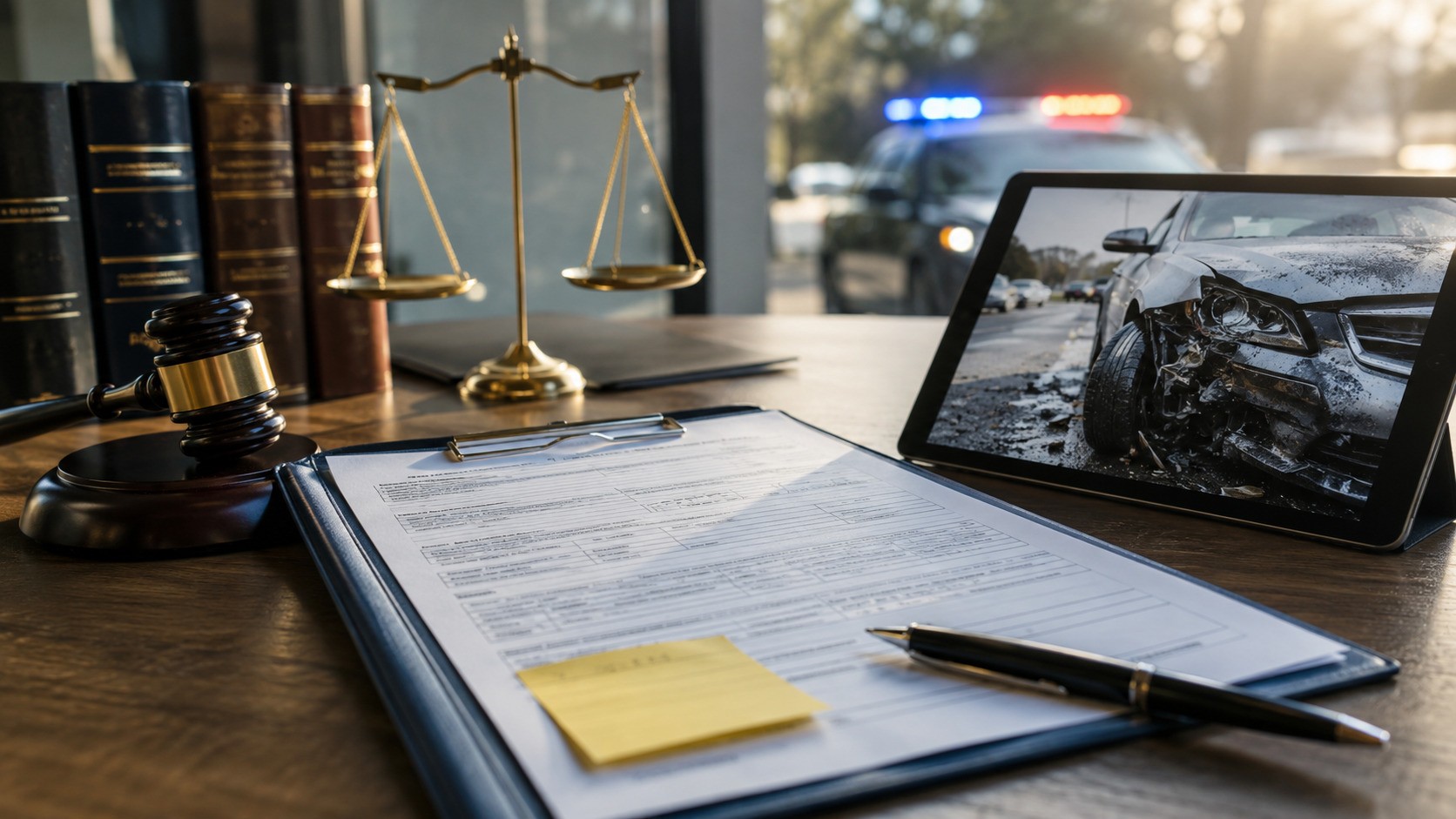
You did everything right after the collision. After pulling over, you checked on the other driver, and waited for the officer to arrive. Then the crash report showed up, and it points the finger at you. Maybe the narrative describes a sequence of events you do not recognize. Perhaps the officer listed a contributing factor next to your name that you know is wrong. Whatever the specifics, that document is now sitting on the desks of two insurance adjusters. It can feel like the case was decided before it ever started.
Take a breath. In Georgia, a police crash report matters, but it is not the final word on who caused a wreck. Once you understand what the report is, what it is not, and how the state’s fault rules work, you will see real options. This article walks through those options under Georgia law.
When an officer responds to a collision in Georgia, the officer completes a standardized statewide form. It is commonly called the Georgia Motor Vehicle Crash Report. Agencies submit these reports electronically. The Georgia Department of Transportation collects the data for statewide crash records. Whether the responding agency is a city police department, a county sheriff’s office, or the Georgia State Patrol, the form looks essentially the same.
The report captures the date, time, and location of the crash. It identifies each driver, each vehicle, and each insurance carrier. Sections cover road conditions, weather, lighting, injuries, and whether anyone was cited. The officer also selects codes for what the form calls contributing factors, writes a short narrative describing what happened, and draws a diagram showing the position of the vehicles.
Georgia law requires drivers to report certain crashes to law enforcement in the first place. O.C.G.A. § 40-6-273 covers collisions involving injury, death, or apparent property damage of $500 or more. A driver involved in one must immediately notify police. Because that threshold is so low, most collisions on Georgia roads generate an official report.
Insurance adjusters lean on the crash report because it is usually the first neutral-looking account they receive. The officer had no stake in the outcome. That person arrived on scene, spoke with the parties, and wrote things down. From an adjuster’s chair, that looks like a reliable starting point.
Adjusters also handle large caseloads. A report that appears to settle the fault question lets them move faster. If the narrative says you turned left in front of oncoming traffic, the other driver’s insurer will likely assume you were at fault from day one. Your own carrier may quietly make the same assumption.
None of this means the report is correct. It means the report is influential. Those are two very different things.
The crash report is not a legal determination of fault. An officer does not have the authority to decide civil liability. No Georgia court treats the report as a binding ruling on who must pay for the damage.
Consider how the report is created. In the overwhelming majority of crashes, the officer was not present when the collision happened. Officers arrive afterward, look at vehicle positions and debris, and listen to the drivers and any witnesses. Under those conditions, the narrative and the codes reflect the officer’s best reconstruction. That reconstruction is filtered through incomplete information gathered in a stressful setting.
Georgia courts have long recognized this. As a general rule, an investigating officer’s opinion about which driver caused a crash is not admissible at trial unless the officer qualifies as an expert in accident reconstruction. Most patrol officers do not. Officers can testify to what they personally observed, such as skid marks, vehicle damage, and where the cars came to rest. Their conclusion about who was at fault is a different matter.
The report itself also faces hearsay problems. Statements the other driver made to the officer, repeated in the narrative, are an out-of-court account offered for its truth. That is exactly what hearsay rules are designed to keep away from a jury. In practice, a jury in a Georgia car accident trial often never sees the crash report at all.
Georgia is an at-fault state. The driver responsible for a crash, through that driver’s insurer, pays for the resulting harm. But responsibility is rarely all or nothing. The state follows a modified comparative negligence rule found in O.C.G.A. § 51-12-33.
Under this rule, a jury assigns each party a percentage of fault. An injured person’s recovery is reduced by that person’s own share. Someone who is 30 percent at fault for a crash with $100,000 in damages can recover $70,000. The cutoff is 50 percent. A person who is 50 percent or more responsible recovers nothing.
This framework matters enormously when you are challenging a report. You do not need to prove that you were flawless. What you need is to show that your share of responsibility is less than the report suggests, and ideally less than half. Shaving a fault assessment from 100 percent down to 40 percent can be the difference between a denied claim and a paid one.
Who decides those percentages? During the claims process, insurers negotiate them. If the case goes to trial, a jury does. The officer who wrote the report is not the decision maker in either setting.
Reports go wrong in predictable ways. Direction of travel is a frequent problem, especially at complex intersections or on divided highways. Vehicles get mislabeled, so the facts described for Vehicle 1 actually belong to Vehicle 2. Weather and lighting codes are sometimes filled in from memory hours later.
Witness information is another weak spot. A bystander who saw everything may have left before the officer arrived, or may have been overlooked because the officer was busy with traffic control and injuries. If only one driver’s account made it into the narrative, the report will naturally tilt in that driver’s favor.
Language barriers, injuries, and shock all affect what gets recorded. A driver being loaded into an ambulance cannot give a detailed statement. One who is rattled may say something imprecise that becomes the official version. Meanwhile, the calmer or more talkative driver’s story fills the gap.
Diagrams deserve a close look as well. It is not unusual for the diagram to conflict with the narrative, or for the contributing-factor codes to conflict with both. Those inconsistencies are exactly the kind of thing that undermines a report’s credibility with an adjuster or a jury.
You cannot challenge what you have not seen. Request a copy from the investigating agency, whether that is a municipal police department, a sheriff’s office, or the Georgia State Patrol. Many Georgia crash reports are also available online through BuyCrash. That is the vendor used by the Georgia Department of Transportation for report distribution. A modest fee typically applies. Crash reports are public records under Georgia’s Open Records Act. An agency should not refuse to release yours.
Read the entire document, not just the narrative. Check your name, address, license number, plate, and insurance details. Look at the diagram and confirm it matches the road layout you remember. Compare the narrative to the contributing-factor codes. Note the names and contact details of any witnesses listed, and note who is missing.
Write down every discrepancy while your memory is fresh. Even small errors help. A report with several factual mistakes is easier to question on the bigger issues.
Not every part of the report is equally open to correction. Objective facts such as the spelling of your name, your insurance policy number, or the direction you were traveling can be documented and corrected. Agencies generally handle those requests without much resistance when you supply proof.
The officer’s conclusion about who caused the crash is different. That is an opinion, and officers rarely reverse an opinion once it is on paper. What they will sometimes do is attach a supplemental statement or amended report. That supplement can add your account, add a witness, or note new evidence. Even if the original narrative stays intact, that supplement becomes part of the official record and travels with the report.
Knowing this distinction keeps your expectations realistic. Push hard on factual corrections. For the fault opinion, aim to get your side documented rather than expecting the officer to concede.
Contact the agency’s records division and ask about its process for amending a crash report. Some departments route requests to the reporting officer, while others involve a supervisor. Ask specifically whether you can submit a written statement, photographs, dashcam footage, or witness contact information.
Keep your submission short, factual, and calm. State what the report says, state what actually happened, and attach your evidence. Avoid arguing about the officer’s judgment or accusing anyone of bias. Records staff and officers respond far better to a polite request supported by proof than to a heated complaint.
Georgia law does not obligate an officer to change a report simply because a driver disagrees with it. If the officer declines, do not treat that as a defeat. You still have your evidence, and it does not lose value because it never made it onto the form.
The best answer to a flawed report is a well-organized body of independent evidence. Start with anything recorded at the moment of impact. Dashcam footage from your vehicle is powerful. If your car has an event data recorder, often called a black box, it may have captured speed, braking, and throttle data before impact. Preserving that data quickly is important. It can be overwritten or lost when the vehicle is repaired or scrapped.
Look for outside cameras next. Gas stations, restaurants, apartment complexes, and retail stores frequently have cameras pointed at nearby roadways. Most systems overwrite footage within days or weeks, so ask immediately. Note that many public traffic monitoring cameras in Georgia do not retain recordings, which makes private footage even more valuable.
Photographs matter more than people expect. Pictures of both vehicles, the debris field, skid marks, traffic signals, and sight lines all help. They show an adjuster or reconstruction expert what the report may have missed. If you did not take photos at the scene, return as soon as it is safe and photograph the location under similar lighting.
Witnesses can outweigh an officer’s guess. Track down anyone who saw the crash, get a written or recorded statement, and collect current contact information. A neutral witness who contradicts the report’s narrative can shift an adjuster’s position quickly.
Your own records fill in the rest. Medical records document injuries and their timing. Repair estimates and photos of damage patterns can show angles of impact. Cell phone records can rebut a claim that you were distracted. The 911 recording sometimes captures a driver’s first, unguarded description of what happened.
If the officer issued you a citation at the scene, treat it as part of the fault dispute, not a separate annoyance. Simply paying the ticket is legally the same as pleading guilty. In a later civil case, a guilty plea to a traffic offense can be introduced as an admission that you committed the violation. That is a gift to the other side.
Georgia offers an alternative. A plea of nolo contendere, if the court accepts it, resolves the citation without admitting guilt. Under O.C.G.A. § 17-7-95, a nolo plea cannot be used as an admission against you in a civil suit arising from the same events. Courts have discretion over whether to accept the plea, and there are limits on how often it can be used for driver’s license purposes, so talk with an attorney before choosing this route.
Contesting the ticket is the third option. Winning in traffic court does not decide the civil case, but it removes a damaging admission and forces the officer to explain the basis for the citation under oath. Sometimes that testimony reveals just how little the officer actually saw.
Your own policy almost certainly requires you to report the crash and cooperate with your insurer. Do that promptly. The other driver’s insurer is a different story. You are not required to give that company a recorded statement. Doing so before you have reviewed the report and gathered your evidence rarely helps you.
When you do communicate with either adjuster, put your position in writing. Explain the errors in the report, attach your supporting evidence, and ask that it be added to the claim file. Adjusters can and do revise fault assessments when presented with credible contrary evidence. That is especially true when the report is internally inconsistent or was based on only one driver’s account.
Keep Georgia’s deadlines in mind while all of this is happening. The statute of limitations for a personal injury lawsuit is generally two years from the date of the crash under O.C.G.A. § 9-3-33. Claims for vehicle damage generally carry a four-year limit under O.C.G.A. § 9-3-31. Negotiations with an insurer do not pause those clocks. Georgia’s minimum liability coverage is $25,000 per person and $50,000 per accident for bodily injury, plus $25,000 for property damage. A serious crash can quickly exceed those limits.
Plenty of minor disputes resolve without a lawyer, especially when the only issue is a factual error the agency is willing to fix. Other situations call for professional help. Significant injuries, a citation against you, or an adjuster who refuses to look past the report are all strong signals. So is a fault assessment that puts you at or above 50 percent.
An experienced Georgia car accident attorney knows how to obtain event data recorder downloads, subpoena footage, retain accident reconstruction experts, and depose the investigating officer. Attorneys also understand how local adjusters and courts treat crash reports, which varies more than most drivers realize. Most personal injury lawyers in Georgia offer free consultations and work on a contingency basis. Getting an opinion costs you nothing up front.
A crash report that blames you is a serious problem, but it is not a verdict. The officer usually did not see the collision, and the report’s fault opinion is generally not admissible at trial. Georgia’s comparative negligence system lets you recover as long as your share of fault stays under 50 percent. Insurers rely on the report because it is convenient, not because the law says they must.
Get the report, read it critically, correct what can be corrected, and build your own evidence. Handle any citation strategically, communicate with insurers in writing, and watch the deadlines. If the stakes are high, get a lawyer involved early. Drivers who take these steps regularly turn a report that looked like the end of the story into just one document among many.
This article provides general information about Georgia law and is not legal advice. Every crash is different, and you should consult a licensed Georgia attorney about your specific situation.