Contact us
Send Us Your Case Details
We’ll respond and let you know the best way to proceed with your case.


Few roads in Gwinnett County stay as busy as Highway 78. Known locally as Stone Mountain Highway, this stretch of U.S. Route 78 cuts straight through the heart of Snellville, carrying tens of thousands of vehicles every single day. Commuters heading toward Atlanta, shoppers pulling in and out of strip malls, and families running everyday errands all share the same crowded lanes. That heavy mix of traffic, combined with the road’s design, makes it one of the more collision-prone corridors in the area.
At Eric Sterling Law Firm, we have seen how a routine drive on this highway can turn into a life-altering event in a matter of seconds. A fender-bender at a red light, a sideswipe during a lane change, or a violent T-bone at an intersection can leave you injured, out of work, and buried in medical bills. Understanding why crashes happen here, and knowing exactly what to do afterward, can protect both your health and your legal rights. Below, we break down the most common causes of wrecks on this corridor and walk you through the steps that matter most after a collision.
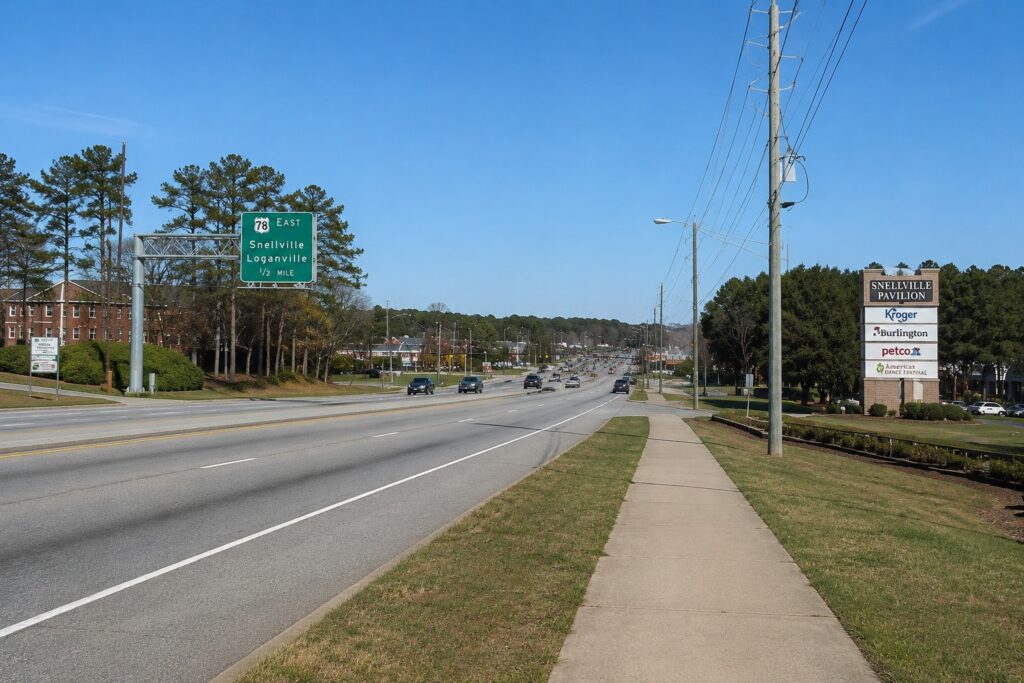
Highway 78 is not a quiet residential street. It runs as a wide, multi-lane arterial that connects the Stone Mountain area in DeKalb County, passes through central Snellville, and continues east toward Loganville and the Walton County line. Six lanes of traffic move through the city center, lined on both sides by shopping centers, restaurants, gas stations, banks, and office buildings.
That commercial density is exactly what creates danger. Dozens of driveways and curb cuts feed directly onto the highway, so vehicles are constantly slowing to turn, merging back into fast-moving lanes, or crossing several lanes at once to reach a destination. Drivers traveling at posted speeds can suddenly encounter cars braking hard ahead of them. Conflict points multiply with every shopping plaza entrance, and each one is a chance for two vehicles to occupy the same space at the same moment.
The intersection of Highway 78 and State Route 124, also called Scenic Highway, ranks among the busiest junctions in all of Snellville. Heavy turning volume, multiple signal phases, and frequent congestion have made this crossing a long-running focus of state roadwork. Georgia’s Department of Transportation has reconfigured portions of the intersection to improve flow and safety, yet the sheer number of vehicles passing through keeps the risk elevated. Drivers who do not know the lane patterns sometimes make last-second moves that catch everyone around them off guard.
Rush hour only compounds these problems. Morning and evening commutes pack the corridor, and stop-and-go conditions leave little margin for error. When one distracted or impatient motorist misjudges a gap, the result can ripple across several vehicles in a chain reaction. Weekends bring their own surge as shoppers flood the retail centers that line both sides of the road.
No two wrecks are identical, but certain patterns appear again and again on this stretch of road. Recognizing them can help you drive more defensively and understand what may have caused your own collision.
Phones remain one of the leading culprits behind wrecks on Highway 78. A driver glancing at a text for even two seconds can drift into another lane or fail to notice braking traffic ahead. Georgia’s hands-free law prohibits holding a phone while driving, yet violations happen constantly. Distraction is not limited to phones, either. Eating behind the wheel, adjusting a navigation screen, or turning to talk with passengers can pull a driver’s attention away at the worst possible moment.
Stop-and-go traffic produces frequent rear-end crashes along the corridor. Vehicles bunch up at red lights and turn lanes, and a following driver who is not paying close attention can slam into the car ahead. Such wrecks often cause whiplash, back injuries, and concussions, even at relatively low speeds. Many people walk away thinking they are fine, only to discover painful symptoms a day or two later.
Because so many businesses line the road, drivers are forever turning across traffic or pulling out of parking lots. A motorist exiting a shopping center may misjudge an oncoming vehicle’s speed and pull out too soon. Left turns across multiple lanes are especially hazardous, since a turning driver has to track gaps in traffic moving in two different directions at the same time. One mistake in that split-second judgment can lead to a high-speed broadside.
Certain sections of Highway 78 tempt drivers into higher speeds, and frustrated commuters often weave between lanes to get ahead. Tailgating, abrupt lane changes, and running yellow lights all raise the odds of a serious wreck. Speed also lengthens the distance a vehicle needs to stop, which can turn a near-miss into a violent impact. Aggressive maneuvers near a packed intersection rarely save more than a few seconds, but they routinely cause crashes.
Six lanes of traffic mean constant merging. Motorists shifting lanes without checking their blind spots cause sideswipes and force other drivers off the road. The danger grows near the SR 124 intersection, where vehicles jockey for position to reach the correct turn lane. People realizing too late that they are in the wrong lane sometimes cut across traffic without warning.
Busy signalized intersections see a steady stream of T-bone and angle collisions. A driver racing to beat a changing light may broadside a vehicle entering on a fresh green. Side-impact crashes tend to cause some of the most severe injuries, because a car door offers very little protection compared with the front or rear of a vehicle. Victims in these wrecks frequently suffer broken bones, internal injuries, and head trauma.
Alcohol and drugs continue to factor into collisions on this corridor, particularly at night and on weekends. An impaired driver reacts slowly, struggles to stay within a lane, and sometimes fails to brake at all. People hurt by a drunk or drugged driver often suffer catastrophic harm through no fault of their own. Holding that driver accountable is one of the clearest examples of why these claims matter.
Rain slicks the pavement and cuts visibility, and Georgia storms can roll in quickly. Wet roads lengthen braking distance, while glare at sunrise and sunset can blind drivers heading east or west along the highway. Fog and heavy downpours add yet another layer of risk to an already demanding road. Slowing down and increasing following distance in bad weather is one of the simplest ways to stay safe here.
Foot traffic between shopping centers creates real danger on such a wide, fast-moving road. Crosswalks can be spaced far apart, and some pedestrians cross mid-block to save time. A driver focused on traffic signals may never see someone stepping off the curb until it is too late. Pedestrian collisions on a high-speed arterial frequently produce devastating injuries.
The force involved in a highway collision can harm the body in lasting ways. Whiplash and other neck strains are extremely common, especially in rear-end wrecks. Concussions and more serious traumatic brain injuries often follow head impacts, even when no object strikes the skull directly. Broken bones, herniated discs, and spinal injuries show up regularly in higher-speed and side-impact crashes. Some victims face soft-tissue damage that lingers for months, while others deal with emotional trauma such as anxiety about driving again. Because certain injuries do not announce themselves right away, prompt medical evaluation is essential after any wreck.
The minutes following a collision are stressful and disorienting. Taking the right steps protects your safety first and your potential claim second. Here is a clear sequence to follow.
Knowing how Georgia handles injury claims helps you make smart decisions after a wreck on Highway 78. A few core rules shape nearly every case.
Georgia is an at-fault state. Whoever causes a crash, along with that driver’s insurer, is responsible for the resulting damages. You generally pursue compensation by filing a claim against the at-fault party’s liability coverage, or in some situations by filing a lawsuit.
You have a limited time to file. Under O.C.G.A. § 9-3-33, the statute of limitations for most personal injury claims in Georgia is two years from the date of the injury. Claims for property damage carry a longer four-year window. Letting the deadline pass usually ends your right to recover, so acting promptly is critical.
Fault can be shared. Georgia follows a modified comparative negligence rule under O.C.G.A. § 51-12-33. You can still recover damages as long as you are less than 50% at fault, though your award is reduced by your own share of responsibility. As an example, a driver found 20% at fault on a $100,000 claim would recover $80,000. Anyone judged 50% or more at fault recovers nothing, which is precisely why insurance companies work so hard to pin blame on victims.
Minimum insurance limits are modest. State law requires drivers to carry liability coverage of at least $25,000 per person and $50,000 per accident for bodily injury, plus $25,000 for property damage. Those limits, often written as 25/50/25, can fall far short of the true cost of a serious injury. Georgia does not require uninsured or underinsured motorist coverage, although carrying it offers valuable protection when the at-fault driver lacks adequate insurance.
Several types of damages may be available. Compensation can include medical bills, lost wages, future care, property damage, and pain and suffering. The overall value of a claim depends on the severity of your injuries, the strength of your evidence, and how the crash has affected your daily life.
Even careful people make missteps after a wreck. Waiting too long to see a doctor gives insurers room to argue that your injuries are minor or unrelated to the collision. Posting about the accident on social media can hand the other side ammunition to use against you. Accepting a fast settlement before you understand the full extent of your injuries often leaves money on the table, since some medical problems take weeks to fully appear. Trusting the at-fault driver’s insurer to treat you fairly is another frequent error, because adjusters are trained to minimize what the company pays out.
Recovering from a crash on Highway 78 is hard enough without battling an insurance company on your own. Our team investigates the wreck, gathers and preserves evidence, identifies every available source of compensation, and handles the adjusters so you can focus on healing. We know this corridor, its troublesome intersections, and the way these collisions tend to unfold.
Based in Lawrenceville, Eric Sterling Law Firm represents injury victims across Gwinnett County and throughout the state of Georgia. We take on car accidents, truck wrecks, motorcycle collisions, and other personal injury matters with the same relentless focus on results. Consultations are free, and you owe nothing unless we recover compensation for you.
Highway 78 will remain a busy, demanding road for the foreseeable future, and crashes here are a daily reality. Driving attentively, leaving plenty of room to brake, and respecting the corridor’s many turning points can meaningfully lower your risk. Should a wreck happen anyway, stay calm, document the scene, get medical care, and protect your rights from the start. Reaching out to an experienced attorney early gives you the best chance at a full and fair recovery.
This article is for general informational purposes only and does not constitute legal advice. Every situation is different. For guidance about your specific circumstances, please consult a licensed Georgia attorney.