Contact us
Send Us Your Case Details
We’ll respond and let you know the best way to proceed with your case.

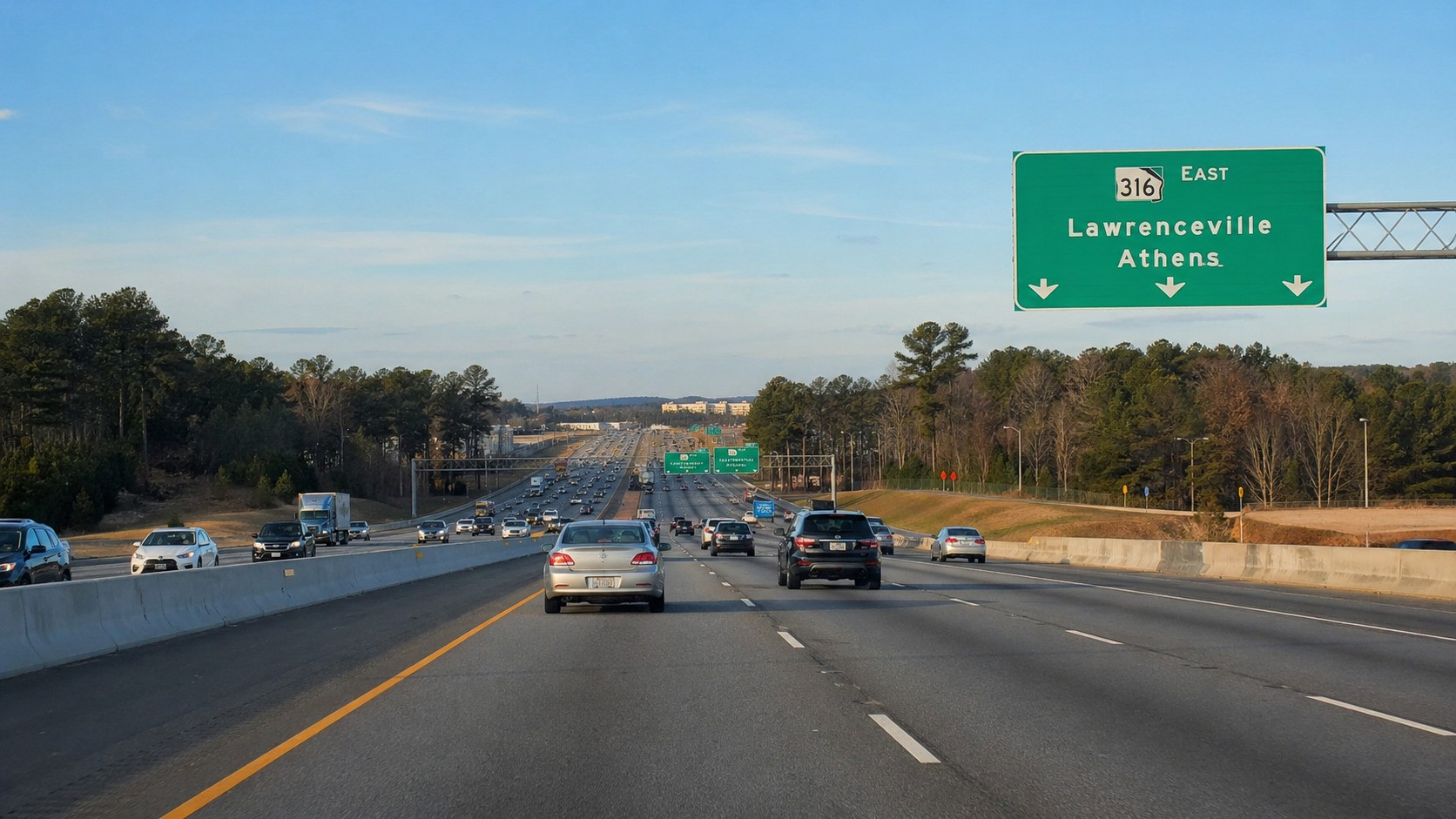
If you live in Gwinnett County, you already know Highway 316. You probably take it to get to work, drop the kids off at school, drive out toward Athens for a Georgia game, or grab lunch off Sugarloaf. It is one of the busiest east to west routes in the northeast metro. It is also one of the most dangerous roads in the state.
Highway 316, officially State Route 316 and often called University Parkway, runs about 39 miles from Interstate 85 in Gwinnett County to State Route 10 just outside Athens. Roughly 16 of those miles sit inside Gwinnett, which means a huge chunk of the most heavily traveled section falls in our backyard. Year after year, this stretch produces some of the worst collisions in metro Atlanta.
If you have driven 316 long enough, you have seen the aftermath. Flashing lights at Sugarloaf Parkway. Eastbound lanes shut down at Buford Drive. A pickup folded into the back of a sedan near Hi-Hope Road. The numbers are sobering. Georgia Department of Transportation data show that intersections along the SR 316 corridor average about 151 injury crashes and 408 property damage crashes every year. A GDOT corridor study found that 65 percent of the route experiences crash rates higher than the state average.
Once you understand how 316 was built and how drivers actually use it, the pattern of crashes starts to make sense.
The biggest issue with Highway 316 is that it does not know what it wants to be.
The first 5.5 miles or so, from I-85 east to about the Buford Drive exit near Lawrenceville, is a true limited access freeway. Grade separated interchanges, on ramps and off ramps, no cross traffic. Speed limit 55. That section behaves the way drivers expect a highway to behave.
Then it changes.
From Buford Drive heading east through Lawrenceville and out toward Dacula, 316 keeps the same look. Two lanes in each direction. Wide grassy median. Big shoulders. The right of way feels like an interstate. The speed limit stays at 55 for a stretch, then climbs to 65 once you get past the more developed sections. But the design quietly stops being a freeway. There are signalized intersections. Cars stopped at red lights in the middle of a high speed road. Drivers crossing four lanes of traffic from side streets. Trucks turning left across multiple lanes from a center turn lane.
That mismatch is the problem. The road looks like an interstate, so people drive it like an interstate. Then they come up on a stopped line of cars at a traffic light, or a driver pulling out from a small county road, and there is not enough time to react. State and federal crash studies of corridors like this one consistently show that high speed roads with at grade intersections produce far more severe crashes than either true freeways or true surface streets.
Not every mile of 316 is equally risky. A handful of areas produce most of the wrecks. Working west to east, here is what to watch for.
The western end of 316 dumps drivers into one of the most complex interchanges in the state. The I-85 and SR 316 junction in Duluth handles some of the heaviest traffic volumes in metro Atlanta. GDOT rebuilt it in 2006 with collector distributor lanes, flyover bridges to Pleasant Hill Road, and a separate flyover from 316 westbound to I-85 southbound. The investment helped, but the sheer volume keeps it dangerous.
Drivers approaching from the east on 316 westbound have to make split second decisions about which lane they need: stay on for I-85, peel off for Pleasant Hill Road, or merge into the I-85 northbound or southbound traffic streams. Last second lane changes are constant. This is where the catastrophic September 2023 street race ended. Two cars going more than 100 mph on the SR 316 westbound ramp to I-85 southbound hit a box truck stopped in the emergency lane. One vehicle went over the wall of the elevated ramp and dropped onto the I-85 collector distributor below. Five people died. Three more were injured. The driver was charged with five counts of vehicular homicide along with racing, reckless driving, and several other offenses.
Even without that kind of extreme behavior, this interchange produces a steady stream of merging crashes, sideswipes, and high speed rear ends.
A few miles east, the Sugarloaf Parkway interchange sits in the heart of one of Gwinnett’s busiest commercial zones. Gwinnett Technical College, Sugarloaf Mills, and a long line of warehouses and distribution centers all feed traffic through this point. The interchange itself is a partial cloverleaf, which means traffic entering 316 has to merge in tight, fast, and sometimes blind. Crashes here cluster around the on ramps and the auxiliary lane that runs eastbound to Riverside Parkway. Distracted drivers, last minute exits to chase fast food signs, and trucks getting up to highway speed all play a role.
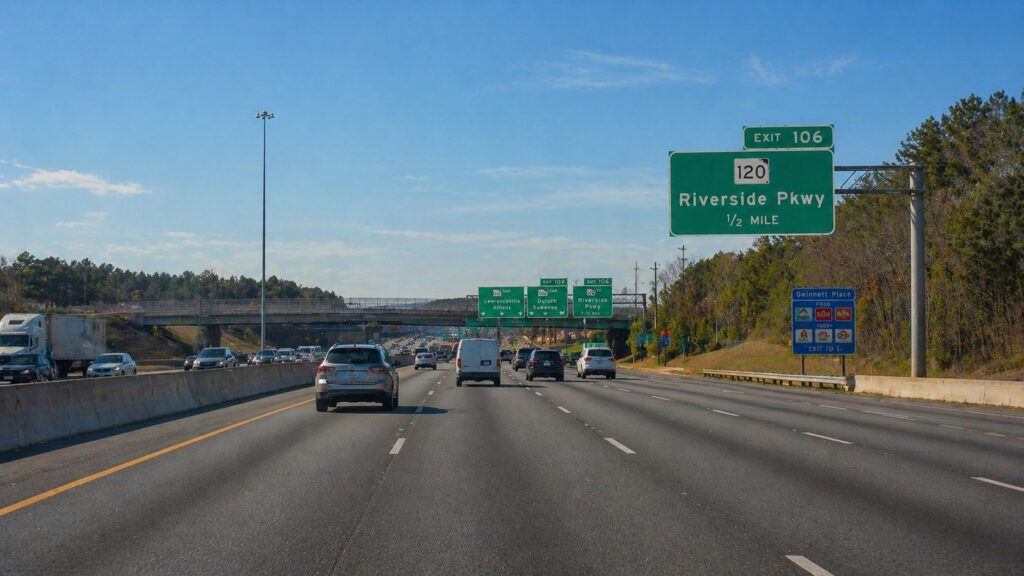
Continuing east, the diamond interchange at Riverside Parkway and the connection to U.S. 29, SR 8, and SR 120 (Duluth Highway) feeds a constant flow of commuter and medical traffic, including Northside Hospital Gwinnett patients and visitors. Rush hour backups are routine. Rear end collisions are the most common crash type in this stretch because traffic on 316 itself slows unexpectedly when ramp queues spill back onto the mainline.
The intersection of Highway 316 and Buford Drive, also called State Route 20, is consistently ranked as the deadliest intersection in Gwinnett County. Multiple traffic safety analyses have flagged this single spot for repeated fatal crashes over the past several years. The volume is brutal. You have through traffic on 316 trying to get to or from the freeway segment, drivers entering and exiting toward the Mall of Georgia and Buford itself, and a steady stream of left turns. The intersection also marks the eastern end of the freeway portion of 316, which means drivers who have been cruising at highway speed suddenly hit signal controlled traffic. On December 10, 2025, a multi vehicle crash near the Buford Drive overpass killed one driver and shut down eastbound 316 for more than three hours.
A short distance east of Buford Drive, Collins Hill Road and Hi-Hope Road both feed onto 316 at locations that are still being upgraded. Hi-Hope Road is one of the next major interchange projects on GDOT’s list, which is a polite way of saying the current configuration produces enough crashes to justify hundreds of millions in reconstruction. Side road drivers crossing 316 here have to time gaps in 55 to 65 mph traffic, often with limited sight distance because of curves and signage. T-bone collisions are the dominant crash type, and at those speeds they are routinely catastrophic.
Before its 2022 conversion to an interchange, Harbins Road was a notorious intersection on 316. The new bridge dramatically reduced cross traffic conflicts at that location. Hurricane Trail and Hurricane Shoals Road, both still at grade, did not get that treatment yet. Both are part of a 1.5 mile reconstruction project between Cedars Road and Fence Road. Until the new interchanges open, drivers entering and exiting 316 at these points are still doing it the old fashioned way: yielding to four lanes of high speed traffic with no protected ramp.
Highway 316 and Winder Highway in Dacula has its own grim history. In 2015, two high school aged brothers were killed at that intersection while attempting to cross the highway. Drivers on that stretch routinely treat 316 as an expressway, even though the at grade design demands far more caution. The interchange replacement here is one of the larger reconstruction projects on the corridor: U.S. 29 / SR 8 will be raised nearly 30 feet, and a new bridge will span 316 entirely. Until that work is finished, this intersection remains one of the most dangerous on the route.
The intersection of 316 and Fence Road, also in Dacula, has been called the most dangerous intersection in all of Gwinnett by some traffic safety analyses. The speed limit on 316 here is 65 mph, and drivers crossing or turning from Fence Road have to judge gaps in two lanes of high speed traffic with almost no margin for error. Failure to yield crashes are the most common type, and because of the angles involved, T-bone impacts at high speed are frequent. A new interchange at Fence Road is part of GDOT’s improvement plan, but it has not been built yet.
These are not isolated tragedies. They are the predictable outcome of a road that mixes interstate speeds with surface street access points, all packed into one of the fastest growing counties in the state.
Beyond the design issues, several patterns keep showing up in 316 crash reports.
Speeding is the obvious one. Gwinnett County police have repeatedly identified speeding as the leading cause of serious crashes in the county, and the long sight lines on 316 invite it. People hit 75 or 80 in a 65 zone without thinking about it.
Distracted driving runs a close second. Georgia passed its hands free law in 2018, but enforcement only goes so far. The Governor’s Office of Highway Safety has reported that Georgia has one of the highest rates of distracted driving in the country. On a road like 316, where you might come up on stopped traffic at a light with no warning, even a two second glance at a phone can be the difference between braking in time and not braking at all.
Failure to yield is a recurring factor at the at grade intersections. Drivers misjudge the speed of oncoming 316 traffic because the road looks like a freeway. They pull out, cross over, or turn left thinking they have more time than they really do.
Tractor trailers and commercial vehicles add another layer. Highway 316 is a major freight route between Atlanta and Athens, and the corridor is lined with warehouses and distribution centers, especially east of Sugarloaf Parkway. Loaded trucks need much more distance to stop than a passenger car, and a rear end crash involving an 80,000 pound truck is rarely a fender bender.
Weather complicates everything. The wide grassy median and limited shoulder space in some sections turn rain into a real problem, and hydroplaning on 316 happens often enough that local body shops can almost predict their workload by the forecast.
Georgia DOT has not ignored the problem. In 2021, Governor Brian Kemp and GDOT announced a 35 mile reconstruction plan for SR 316 across Gwinnett, Barrow, and Oconee counties, projected to cost about $829 million. The goal is to convert the corridor into a true freeway by removing every signalized at grade intersection and replacing it with an interchange or grade separated bridge.
GDOT data suggest these conversions reduce injury crashes by roughly 28 percent and non injury crashes by about 27 percent at each intersection. Three projects have already been completed, including a new interchange at Harbins Road in Gwinnett, which opened in 2022. Construction is underway or planned on more than two dozen others, including new interchanges at Hi-Hope Road, Fence Road, Hurricane Trail, Hurricane Shoals Road, Cedars Road, and the SR 8 Winder Highway intersection. Frontage roads are being added on both sides of 316 to support future access.
This is good news. It is also a long road. Most of the major projects are not scheduled to wrap up until 2028 or later, and several are still in design. Until those interchanges are finished, the corridor remains exactly the kind of mixed use, mixed speed environment that produces the most severe wrecks.
In the meantime, the construction itself is a hazard. Lane shifts, narrowed shoulders, dropped speed limits, and confused drivers all contribute to additional crashes during the build out. Anyone who has driven through the active work zones on 316 lately knows the feeling.
If you have been hurt in a crash on Highway 316, your case is rarely simple. A few features of these collisions tend to complicate them more than a typical wreck on a side street.
The speeds involved usually mean serious injuries. Spine injuries, traumatic brain injuries, broken bones, internal injuries, and long term soft tissue damage are common on this corridor. Higher injury severity means higher medical bills, longer recovery times, more lost wages, and more pushback from insurance carriers trying to limit payouts.
Multiple vehicles are often involved. A rear end collision at 65 mph in heavy traffic can become a four car pileup in seconds. Sorting out who is responsible when several drivers, several insurance companies, and possibly a commercial trucking company are all in play takes real investigation.
Georgia is a modified comparative negligence state. Under O.C.G.A. § 51-12-33, you can still recover damages if you were partially at fault, but only if you were less than 50 percent responsible. Your recovery is reduced by your percentage of fault. If a jury decides you were 20 percent at fault and your damages totaled $200,000, you walk away with $160,000. If they decide you were 50 percent or more at fault, you get nothing. Insurance adjusters know this rule cold, and they will work hard to push your share of the blame as high as they can.
Georgia has a two year statute of limitations on personal injury claims under O.C.G.A. § 9-3-33. The clock starts on the date of the wreck. There are limited exceptions for minors and a few other situations, but for most adults, missing that deadline ends the case before it begins. Claims against city or county government bodies have even tighter notice requirements.
If you find yourself in a wreck on Highway 316, the first priorities are the obvious ones. Get yourself and your passengers somewhere safe if you can do so without making things worse. Call 911. Wait for officers. Get checked out by EMS even if you feel okay, because adrenaline masks injuries and some of the most serious internal damage does not show symptoms for hours or even days.
Beyond that, a few steps will protect your rights. Photograph everything: the vehicles, the road, the debris, your injuries, the weather, the lane configuration. Get the names and phone numbers of any witnesses who stop. Ask the responding officer for the report number. Avoid giving recorded statements to the other driver’s insurance company until you have spoken with a lawyer. Anything you say can and will be used to push your share of fault closer to that 50 percent line.
Then call a personal injury attorney who handles cases on this corridor. Highway 316 crashes have specific patterns. The lawyers who work them understand the intersection histories, the GDOT data, the way Lawrenceville and Gwinnett County officers write their reports, and what the common defense arguments will be. Local knowledge matters.
At Eric Sterling Law, we have built our practice around serving people in Gwinnett County, including drivers and families affected by serious crashes on Highway 316. We know this road. We know the intersections that keep producing wrecks. We know how to investigate, preserve evidence, deal with insurance carriers, and pursue full compensation under Georgia law.
If you or someone you love has been hurt in a 316 crash, do not wait. The two year deadline runs faster than people think, and every week that passes makes evidence harder to recover. Reach out for a free consultation. There is no fee unless we win.
Highway 316 will eventually become a safer road. The state is spending close to a billion dollars to make sure of it. Until that day comes, the people who use it every day deserve real help when something goes wrong.