Contact us
Send Us Your Case Details
We’ll respond and let you know the best way to proceed with your case.

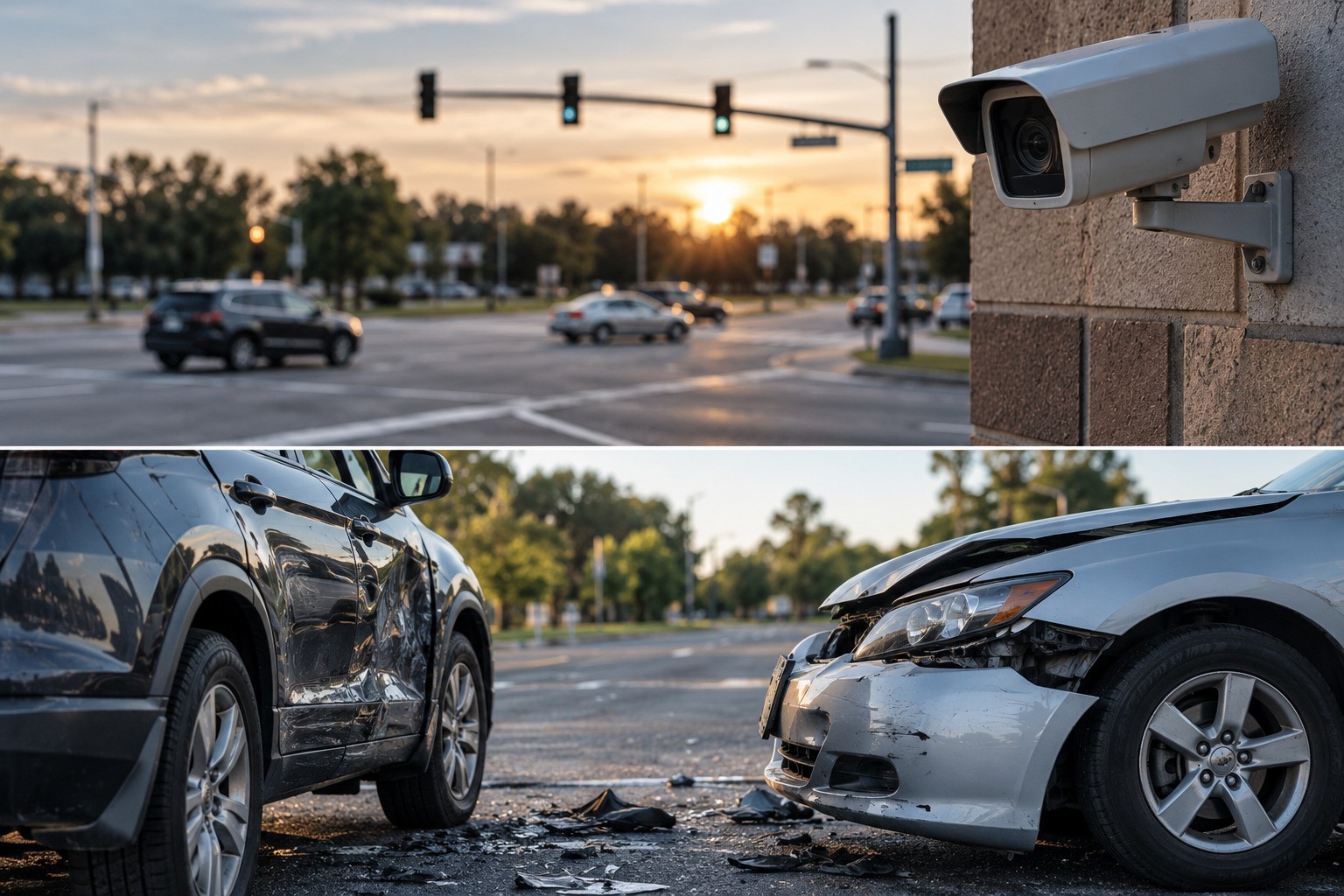
A car crash often happens in a matter of seconds. Afterward, the drivers involved may remember those seconds very differently. One person says the light was green. The other swears it was red. Without independent proof, an insurance adjuster may treat the dispute as your word against theirs.
Security cameras at nearby businesses can change that. Gas stations, fast food restaurants, banks, pharmacies, and shopping centers across Georgia record their property around the clock. Many of those cameras also capture part of the road. That footage can show how a collision happened, who entered the intersection first, and whether a driver was speeding or distracted.
This guide explains how business camera footage fits into a Georgia car accident claim. You will learn why video matters under Georgia’s fault rules and why speed is so important. It also covers how to request footage and how Georgia courts decide whether a recording can be used as evidence.
This article provides general information about Georgia law. It is not legal advice, and reading it does not create an attorney-client relationship.
Georgia is an at-fault state. The driver who caused a crash, along with that driver’s insurer, is generally responsible for the resulting losses. To recover compensation, you usually need to show that the other driver was negligent and that the negligence caused your injuries.
Fault is often shared in Georgia cases. Under O.C.G.A. § 51-12-33, Georgia follows a modified comparative negligence rule. If you are found partly at fault, your damages are reduced by your percentage of fault. Anyone found 50 percent or more at fault cannot recover damages at all.
That rule gives insurance companies a strong reason to argue that you share the blame. Shifting even a small portion of fault onto you lowers what they may have to pay. Pushing half of it onto you can eliminate your claim entirely.
Clear video can cut through these arguments. A recording does not forget details, and it has no stake in the outcome. When footage shows the other driver running a stop sign, the debate over fault often becomes much shorter.
Evidence rules have also changed recently. Senate Bill 68, signed on April 21, 2025, ended Georgia’s long-standing rule that kept seat belt evidence out of car accident cases. Defense lawyers now have more ways to argue that an injured person contributed to their own injuries. Strong, objective evidence about how the crash happened has become even more valuable as a result.
Surveillance cameras are not designed to film traffic. Most are aimed at doors, registers, gas pumps, drive-through lanes, and parking areas. Still, many of them have a partial view of a street, an intersection, or a parking lot entrance. A collision in one of those spaces may appear in the frame.
Depending on the angle and image quality, footage may reveal the color of a traffic signal at the moment of impact. It can show how fast vehicles were moving compared with one another. A recording might capture a driver drifting across a lane, rolling through a stop sign, or turning without yielding. Video can also show where the vehicles ended up, what the weather and lighting were like, and whether anyone left the scene.
Footage is especially valuable after a hit-and-run. A camera might record the fleeing vehicle’s make, model, color, or license plate. That information can help police identify the driver and may support your insurance claim.
Parking lot collisions are another common example. These crashes often happen at low speed with few witnesses. Retail lots, however, are usually well covered by cameras pointed at exactly the areas where these accidents occur.
Video has limits, too. Cameras may record at a low frame rate, which can make movement look choppy. Glare, rain, darkness, and distance can blur important details. Some recordings capture only part of the crash or begin after the impact. Even imperfect footage can still help, particularly when combined with photos, witness statements, and the police report.
Time is the biggest threat to business camera footage. Most commercial surveillance systems store recordings on a hard drive or in cloud storage with limited capacity. When that storage fills up, the system automatically records over the oldest files. Retention periods vary widely from one business to another. Some systems keep footage for weeks, while others overwrite it within a few days.
Once footage is overwritten, it is usually gone for good. A business owner may not even know that a crash was recorded. Unless someone asks them to save the video, the system will keep running on its normal cycle.
A legal point makes this urgency even greater. Georgia law recognizes a duty to preserve evidence, and courts can sanction parties who destroy relevant evidence. In Phillips v. Harmon, 297 Ga. 386 (2015), the Supreme Court of Georgia held that this duty can arise once litigation is reasonably foreseeable to the party controlling the evidence. That rule applies to the parties in a dispute, however. A gas station or restaurant that simply happened to record your crash is usually not a party to your claim. Such a bystander business generally has no obligation to hold onto footage for you unless a court process requires it.
This is why the first few days matter so much. A prompt, polite request is often the only thing standing between you and permanently lost evidence.
Your health comes first. Call 911 if anyone is hurt, and get medical care even if your injuries seem minor. Under O.C.G.A. § 40-6-273, drivers must promptly report crashes involving injury, death, or property damage of $500 or more to law enforcement. Calling the police also creates an official record of the collision.
Once you are safe, look around the scene. Note every business with a possible view of the crash location. Check storefronts, gas station canopies, bank drive-throughs, and light poles in shopping center lots for cameras. Take photos of any cameras you see, along with business names and addresses. Doorbell cameras on nearby homes are worth noting as well.
Write down the time of the crash as precisely as you can. Your phone’s call log from a 911 call can help confirm it later. Accurate timing makes it much easier for a business to locate the right section of footage.
If you are physically unable to do this, ask a family member or friend to visit the area within a day or two. An attorney can also send someone to canvass the scene on your behalf.
Start by visiting or calling the business as soon as possible. Ask to speak with a manager rather than a cashier. Explain that a car accident happened nearby, give the date and approximate time, and ask whether their cameras may have captured it.
Many managers do not have authority to release footage themselves. Chain stores and franchises often send these requests to a corporate security or legal department. Even when a manager cannot hand over a copy, you can ask them to save the relevant portion of the recording right away.
Follow up in writing. Your letter or email should state the date, time, and location of the crash. Describe the camera views you believe are relevant. Then ask the business to preserve footage from a window of time before and after the collision. Keep a copy of everything you send, and note the name of each person you speak with.
Some businesses will share footage directly with an injured driver. Others will only release it to police, to an attorney, or in response to a subpoena. Company policy, privacy concerns, and liability worries all play a role. A refusal does not necessarily mean the footage is lost, especially if the business agrees to preserve it.
When you receive a copy, ask for the original file format whenever possible. Recording a monitor with your phone reduces quality and can raise questions about authenticity. Ask what system created the recording and whether its clock was set correctly. Those details can matter a great deal if the case goes to court.
If a business will not voluntarily provide footage, formal legal process may be the next option. After a lawsuit is filed, Georgia’s Civil Practice Act allows parties to request documents and other materials from businesses that are not parties to the case. O.C.G.A. § 9-11-34(c) extends these requests to nonparties, and subpoenas can also be used.
The challenge is timing. Most car accident claims do not start as lawsuits. Insurance negotiations can take weeks or months, and footage may be overwritten long before any subpoena is issued. That is why an early preservation request is so important. It keeps the evidence available in case formal legal process becomes necessary later.
Georgia’s filing deadlines work on a much longer clock. The statute of limitations for most personal injury claims is two years under O.C.G.A. § 9-3-33. Claims for damage to personal property, such as your vehicle, generally carry a four-year deadline under O.C.G.A. § 9-3-31. Those deadlines leave time to file a lawsuit, but they do nothing to protect video that disappears in a week.
Business cameras are not the only possible source of footage. Several other options may be worth exploring.
Many people assume state highway cameras recorded their crash. The Georgia Department of Transportation, however, states on its 511GA website that its traffic cameras do not record. Those cameras provide live views for monitoring traffic, and past footage is not available. Requesting GDOT video of your crash will not produce a recording.
Local government cameras are a different story. Some Georgia cities and counties operate their own camera systems, and many police agencies use dash cameras and body-worn cameras. Records held by government agencies can be requested under the Georgia Open Records Act, O.C.G.A. § 50-18-70 and following sections. Agencies generally must respond within three business days, though producing large records can take longer. Certain law enforcement records tied to a pending investigation or prosecution may be withheld.
Private vehicles are another source. Your own dash camera may have recorded the crash, and other drivers at the scene may have one too. Commercial trucks, delivery vans, and some public transit buses are often equipped with cameras. If a commercial vehicle was involved in your crash, its owner is likely a party to your claim. That means the preservation duty discussed in Phillips v. Harmon may apply to its recordings.
Home security systems and video doorbells can also capture street activity. Storage for these devices varies by product and subscription plan. Neighbors are often willing to help when asked quickly and courteously.
Video must be authenticated before a court will admit it. Authentication simply means showing that the recording is what it claims to be. Georgia’s general authentication rule appears in O.C.G.A. § 24-9-901.
The most common approach uses a witness. Someone with knowledge testifies that the video fairly and accurately shows the scene and events. That person might be someone who saw the crash, or someone familiar with the location and the camera system.
Surveillance footage presents a special situation because nobody is usually operating the camera. Georgia addresses this directly in O.C.G.A. § 24-9-923(c). Under that provision, recordings from a device that was not being operated by a person can be admitted if the court finds they reliably show the facts at issue. The date and time must appear on the recording. They must also be shown to have been made at the same time as the events depicted.
That last requirement has practical consequences. Many surveillance systems have clocks that drift or were never set correctly. A timestamp that is off by several minutes, or even hours, is common. Section 24-9-923 is not the only way to admit a recording, since subsection (d) states that it supplements other lawful methods. Still, any clock problem should be documented early. An employee or technician may need to explain how the system works and why the time display was wrong.
Chain of custody matters as well. Keep a record of who copied the footage, when it was copied, and how it was stored. Never edit, trim, or enhance the original file. If a version needs to be clarified or enlarged for presentation, an expert should work from a copy and keep the original intact.
Obtaining business footage involves practical and legal hurdles. Attorneys who handle car accident claims often send preservation letters within days of being hired. They can canvass the scene, identify cameras, and contact corporate legal departments that may ignore individual requests. When necessary, they can file suit and use subpoenas to obtain footage that a business will not release voluntarily.
A lawyer can also analyze footage alongside other evidence. Accident reconstruction experts sometimes use video to estimate vehicle speeds and timing. Paired with the crash report, medical records, and witness statements, footage can form the backbone of a strong claim.
Many Georgia personal injury attorneys offer free initial consultations. Car accident cases are also commonly handled on a contingency fee basis, meaning the fee comes from any recovery rather than from your pocket upfront.
Yes. Nothing in Georgia law prevents you from asking a business to share or preserve its recordings. Whether the business agrees is its own decision, at least until a court orders otherwise.
There is no single answer. Retention depends on the system, its storage capacity, and company policy. Because some systems overwrite recordings within days, you should ask as soon as possible.
Sometimes they will. Officers may request footage during an investigation, particularly after serious injury crashes or hit-and-runs. Routine crash investigations often do not include a search for video, so you should not assume police have it. Contact the investigating agency directly to ask.
Footage cuts both ways. Under Georgia’s comparative negligence rule, you can still recover damages if you were less than 50 percent at fault, although your award is reduced. Do not delete or alter any footage you obtain, even if it seems unhelpful. Georgia courts expect injured people to preserve relevant evidence too, and an attorney can explain how the video affects your claim.
No. GDOT says its traffic cameras do not record, so there is no past footage to request.
Nearby business cameras can provide some of the most persuasive evidence available after a Georgia car accident. Video can resolve disputes about fault, identify hit-and-run drivers, and support your account of what happened. It can also protect you from attempts to shift blame under Georgia’s comparative negligence rule.
The window to obtain that footage is often short. Identify cameras at the scene, contact businesses quickly, and put preservation requests in writing. If you were injured, speaking with a Georgia car accident attorney soon after the crash can help secure valuable video and answer any questions about your accident that you may have.