Contact us
Send Us Your Case Details
We’ll respond and let you know the best way to proceed with your case.

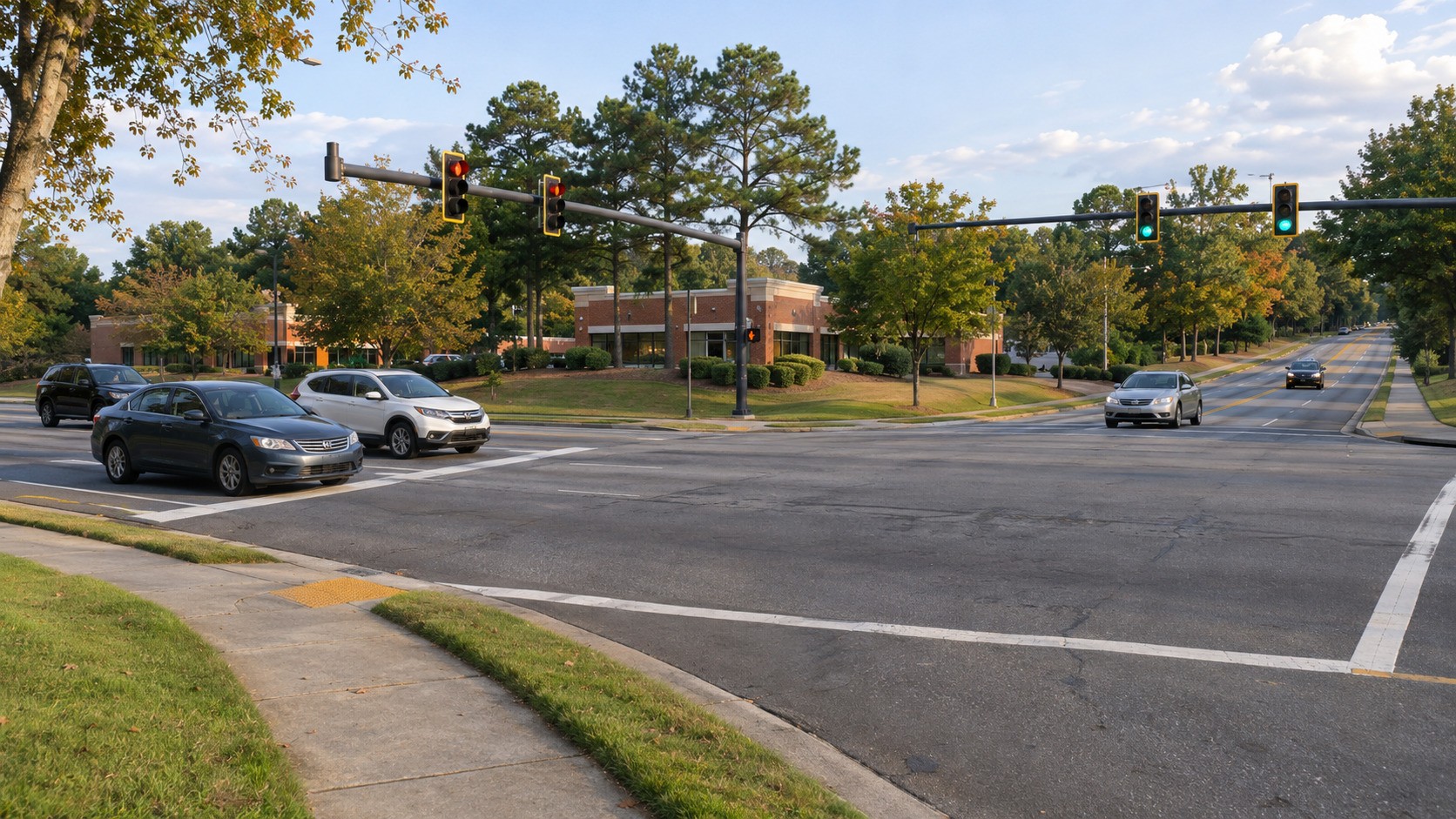
Lawrenceville reports more crashes than any other city in Gwinnett County, and most of them cluster at a short list of intersections. Georgia Department of Transportation (GDOT) crash data ties 13,055 crashes to the city from 2021 through 2025. That is about 75% more than the next city, Suwanee, at 7,434.
The reason is geography. Lawrenceville is the county seat, and State Route 316, US 29, SR 20, SR 120 and SR 124 all meet here. Commuters, hospital traffic, college students, courthouse visitors and freight trucks share the same few crossings every day.
This guide walks through the Lawrenceville intersections with the worst crash records, why they are dangerous, what is being rebuilt, and what Georgia law expects of you before and after a wreck. Every statistic below comes with the years it covers, because crash numbers change every year.
Georgia Department of Transportation crash records tie 13,055 crashes to Lawrenceville between 2021 and 2025. That works out to roughly 2,600 a year, or about seven every single day. The Lawrenceville Police Department handled 10,061 of them, and other agencies worked the rest. Over the same five years, Gwinnett County as a whole recorded 152,284 crashes, more than 80 a day, and roughly half of them were tied to an intersection.
The type of crash tells you where the danger is. Rear-end collisions made up about 44 percent of Gwinnett crashes during that period. Angle crashes, the kind that happen when one driver turns across another driver’s path, made up about 27 percent. Both are intersection crashes at heart. The clock matters too. The 5 p.m. hour produced close to 14,000 crashes countywide over those five years, nearly double the morning rush peak.
Two things are worth knowing before you read any list of dangerous intersections, including this one. The first is that Georgia does not publish an official ranking. The state makes its crash records public through the GDOT Crash Data Dashboard, and every ranking you see online is somebody’s reading of that data for a set of years they chose. The second is that a Lawrenceville mailing address does not mean a road is inside the city. Large stretches of Sugarloaf Parkway and Lawrenceville Highway sit in unincorporated Gwinnett County, where county police work the crashes and the city never counts them. This guide covers both, because nobody notices the city limit when they drive across it.
No single list settles this question, so what follows is the set of intersections that keep surfacing in GDOT crash records, in analyses built on those records, and in local police and news reports. The numbers come from different years and count different things. Some are total crashes and some are fatal crashes only. Read this as the short list of places that have earned their reputation, not as a strict ranking from worst to least bad.
If one intersection inside the city deserves the top spot, it is this one. A road-safety review built on GDOT data counted 126 crashes and one death here from 2020 through 2022. That is about 42 crashes a year, or one roughly every nine days. New Hope Road comes up from south Gwinnett, becomes Jackson Street and heads into downtown, and on the way it crosses State Route 124, a state highway loaded with traffic between Lawrenceville and Snellville. The turn lanes could not hold the cars trying to use them, so traffic stacked up, and stacked-up traffic is where rear-end and left-turn crashes come from.
The city has since rebuilt it. Lawrenceville put the work out to bid in 2022 and paid for it with city and county money plus a $400,000 grant from the Georgia Transportation Infrastructure Bank. Crews added through lanes and turn lanes on New Hope Road and Jackson Street and updated the signals, and the city now reports a significant improvement in congestion. Whether the crash numbers have followed is something the next few years of data will show, so it is still a place to leave extra room.
State Route 316 is a freeway from Interstate 85 until it reaches Buford Drive, and then it is not. This interchange is the eastern end of the freeway section. Drivers who have been cruising at highway speed suddenly meet ramps, signals and local traffic heading to Georgia Gwinnett College and Coolray Field. Buford Drive carries State Routes 20 and 124 here, and Collins Hill Road is served by the same exit, so several streams of traffic are sorting themselves out in a short distance.
The danger is recent as well as real. On December 10, 2025, three vehicles collided on eastbound 316 at Buford Drive shortly before 1 p.m. One driver died at the scene, and Lawrenceville police kept the eastbound lanes closed for more than three hours while they investigated.
Less than a mile east of Buford Drive, Hi Hope Road still crosses 316 at a traffic light. Through traffic expects open highway, while local traffic is turning toward Gwinnett County Police headquarters, the county airport and the industrial parks around it. A signal on a road that feels like a freeway is a setup for hard rear-end crashes and for drivers running a light they did not expect.
The Georgia Department of Transportation is replacing the light with a full interchange. The plan includes bridges, collector-distributor lanes that separate local trips from through traffic, and a roundabout where Hi Hope Road, Hurricane Shoals Road and Airport Road meet. The state’s project record showed construction about 30 percent complete in November 2026, with a construction estimate of roughly $142 million. Until it opens, this is an active work zone on top of a risky crossing.
Cedars Road, beside the Gwinnett County airport, had one of the worst records in the county. An analysis of GDOT data by an Atlanta injury firm counted five fatal crashes there between 2016 and 2021, tied for the most of any intersection in Gwinnett. The reason is easy to picture. Drivers on a side road were trying to cross or turn onto a divided highway where traffic moves at speed.
The state’s answer was to take those movements away. GDOT closed the at-grade crossing as part of its State Route 316 program and lists the Cedars Road project as completed and open to traffic. It belongs on this list anyway, as the clearest example of what the old design cost and why the rest of the corridor is being rebuilt.
Just southwest of the city limits, Lawrenceville Highway, which is US 29, crosses Sugarloaf Parkway and then Lawrenceville-Suwanee Road about 1,000 feet later. Two major signals that close together behave like one oversized intersection. The same injury-firm analysis counted four fatal crashes at the Lawrenceville-Suwanee Road signal alone between 2016 and 2021.
A Walmart and Moore Middle School sit close by and add turning traffic at both ends of the day, and a backup at one light can reach the other. Local injury firms have described this pair, counted together, as having the most crashes in Gwinnett County, although they do not publish the counts behind that claim. This stretch is in unincorporated Gwinnett, so county police handle crashes here.
Sugarloaf Parkway meets 316 at an interchange west of downtown, next to Gwinnett Technical College and the Gwinnett School of Mathematics, Science, and Technology. Four fatal crashes were recorded here from 2016 through 2021. The ramps curve, the traffic includes a lot of trucks, and the two schools send waves of cars through at class times. That mix of fast through traffic, heavy vehicles and drivers in a hurry to make a bell is hard on everyone.
Speeds drop around the Square, but the crashes do not stop. The same road-safety review counted 21 crashes at West Pike Street and Buford Drive in 2022. It counted 20 more that year at East Crogan Street where it meets Buford Drive and Jackson Street, one of them fatal.
Downtown packs through traffic on US 29, drivers hunting for parking and people on foot into a tight grid of short blocks. Most collisions here are low-speed. The exception is anyone walking, because a person in a crosswalk has no protection at any speed, and pedestrian crashes across Gwinnett have been climbing.
South of downtown, Scenic Highway meets Grayson Highway, which is State Route 20. On February 10, 2026, a multi-vehicle crash shut that intersection down. Police reported multiple injuries, and state traffic cameras showed a dump truck that appeared to have caught fire.
On the west side of town, Duluth Highway at Riverside Parkway shows up on several lists published by Gwinnett injury firms, which single out the 4 to 7 p.m. rush as its worst stretch. Those lists do not publish crash counts, so take that one as a local warning and not a statistic.
Look closely at those locations and the same few conditions keep turning up. The first is the queue. Long signal cycles on Scenic Highway, Sugarloaf Parkway and US 29 stack cars bumper to bumper, and a stacked line is one distracted glance away from a rear-end crash. That is why rear-end collisions are the most common crash in Gwinnett, at about 44 percent of the total.
The second is the left turn across several lanes. Angle crashes account for about 27 percent of Gwinnett wrecks, and they tend to cause worse injuries than rear-end crashes because the impact lands on a door instead of a bumper. Every wide road on this list asks drivers to judge a gap across two or three lanes of oncoming traffic, often with a line of impatient cars behind them.
The third is speed that does not match the road. State Route 316 changes from a freeway to a signalized highway right at Lawrenceville, and not every driver slows down when the road does. Time of day piles on. The 5 p.m. hour is the worst of the day by a wide margin, and pedestrian crashes cluster a little later, between 6 and 9 p.m., when it is dark for much of the year. Countywide, pedestrian crashes rose from about 135 in 2021 to roughly 180 or more in each year since 2023.
Two more factors are about people and not pavement. Drivers between 15 and 19 were involved in roughly one of every seven Gwinnett crashes, which matters in a city where a college, a technical college and several high schools feed the same roads. And about 13 percent of Gwinnett crashes were hit-and-runs. A real share of the people who get hit never learn who hit them unless a witness or a camera fills in the gap.
The good news is that three of the worst locations have already been rebuilt or are under construction. The Scenic Highway work at Jackson Street and New Hope Road is finished. The Cedars Road crossing on 316 is closed. And the Hi Hope Road interchange, the largest of the three, is being built now.
The bigger plan behind the 316 projects is to turn the highway into a true freeway with no traffic signals. Gwinnett transportation officials have said their long-term goal is to bring 316 fully up to freeway standards, and GDOT is rebuilding the corridor in stages from Lawrenceville toward Athens. Each signal that comes out removes the exact conflict that made Cedars Road so deadly.
Gwinnett County also received a $200,000 federal Safe Streets and Roads for All grant in 2023 to help pay for a countywide safety action plan. That plan ranks future safety projects on state routes and county roads, which is how the next round of intersection fixes will be chosen.
None of that helps much while the orange barrels are up. Construction makes roads safer in the long run and more confusing in the short run. Expect lane shifts, narrowed shoulders and changing traffic patterns on 316 east of Buford Drive until the Hi Hope Road interchange opens.

Most intersection crashes come down to a driver breaking one of a handful of rules in Title 40 of the Official Code of Georgia. They are worth knowing for two reasons. They keep you out of a wreck, and a violation is strong evidence of fault if a crash ends up in an insurance claim or a courtroom.
Start with the signal itself. O.C.G.A. § 40-6-20 requires drivers to obey traffic-control devices, and a conviction for running a light puts three points on a Georgia license. A red light does allow a right turn in Georgia, but under § 40-6-21 only after a complete stop, only where no sign prohibits it, and only after yielding to pedestrians and cross traffic. When a signal goes completely dark, as happens after storms, Georgia law treats the intersection as an all-way stop. Every driver has to stop as if a stop sign faced each direction.
Turns and spacing come next. Under § 40-6-71, a driver turning left must yield to oncoming traffic that is close enough to be an immediate hazard, which is why the turning driver is usually the one cited after a left-turn crash. Rear-end crashes have their own rule in § 40-6-49, which bars following another vehicle more closely than is reasonable and prudent. Georgia also has a law against blocking the box. Under § 40-6-205, you may not enter an intersection unless there is room for your vehicle on the other side, even when your light is green.
The last two rules are about people outside your car and the phone inside it. Under § 40-6-91, a driver must stop and stay stopped, not merely slow down, for a pedestrian in a crosswalk who is on the driver’s half of the road or within one lane of it. And the Hands-Free Georgia Act, § 40-6-241, makes it illegal to hold a phone or support it with any part of your body while driving. That includes sitting at a red light. The fines are $50 for a first offense, $100 for a second and $150 for a third, with one, two and three points to match.
Georgia puts specific duties on every driver involved in a wreck, and the clock on any claim starts running that day.
The first duty is to stop and stay. O.C.G.A. § 40-6-270 requires you to stop at the scene, give your name, address and vehicle registration number, show your license if asked, and give reasonable help to anyone who is hurt. Leaving the scene of a crash that caused death or serious injury is a felony that carries one to five years in prison.
The second duty is to call the police. Under § 40-6-273, you must notify law enforcement immediately when a crash causes injury, death, or apparent property damage of $500 or more. With what body work costs today, nearly any collision between two cars clears that bar, so the safe habit is to call 911 every time.
The third duty surprises people. If nobody appears seriously hurt and your car can be driven, § 40-6-275 requires you to move it out of the travel lanes. Sitting in the middle of Scenic Highway to preserve the scene is not what Georgia law asks for. Take quick photos of the vehicle positions, the damage and any skid marks, then move to a safe spot.
Pay attention to which agency shows up. Lawrenceville police work crashes inside the city limits and Gwinnett County police work the unincorporated areas, so the patch on the officer’s sleeve tells you where your report will be. Ask for the report number before you leave. Georgia crash reports are available online through the state’s BuyCrash system, and Gwinnett County police also provide copies at their headquarters on Hi Hope Road for five dollars. Get checked by a doctor even if you feel fine, because some injuries take days to show.
Georgia is an at-fault state. The driver who caused the crash is responsible for the damage, usually through liability insurance. The legal minimum under § 33-7-11 is $25,000 per person and $50,000 per crash for bodily injury, plus $25,000 for property damage. Those minimums run out quickly in a serious crash, which is why uninsured and underinsured motorist coverage on your own policy is worth having.
Fault is often shared, and Georgia handles that with modified comparative negligence under § 51-12-33. You can recover damages as long as you were less than 50 percent at fault, but your recovery is reduced by your share. If a jury puts your losses at $100,000 and your fault at 20 percent, you collect $80,000. At 50 percent or more, you collect nothing.
Seat belts now figure in as well. Senate Bill 68, signed on April 21, 2025, ended Georgia’s long-standing ban on seat belt evidence in civil cases. A jury may now consider an occupant’s failure to buckle up when it sorts out fault and damages.
The deadline most people know is two years. Under § 9-3-33, a personal injury lawsuit must be filed within two years of the crash, and a wrongful death lawsuit within two years of the death. Claims for damage to your vehicle and other property get four years under § 9-3-31.
The deadlines people miss involve the government. If your crash involved a City of Lawrenceville vehicle or employee, § 36-33-5 requires written notice of the claim to the city within six months. A claim against Gwinnett County must be presented within twelve months under § 36-11-1. A claim against the State of Georgia, including GDOT, requires written notice within twelve months under § 50-21-26. In a county seat full of city trucks, county buses and police cars, those shorter windows come up more often than you would think.
All of this is general information about Georgia law and not legal advice. Deadlines can shift with the facts of a case, so confirm yours with a Georgia attorney.
None of this means you should avoid Lawrenceville. It means a few specific habits pay off at specific places.
On 316 eastbound, start slowing before you reach Buford Drive. The freeway ends there, and signals and work zones follow. The driver still doing freeway speed at Hi Hope Road is the one who ends up in someone’s trunk. On Lawrenceville Highway, pick your lane well before Sugarloaf Parkway. The two signals are too close together for a late lane change, and a late lane change is how sideswipes happen.
At any red light on Scenic Highway or Sugarloaf Parkway, leave about a car length in front of you and glance at the mirror as traffic comes up behind. Rear-end crashes are the most common kind in Gwinnett, and that gap gives you somewhere to go. When you need to turn left across one of these roads at rush hour, skip the unprotected turn. Use a signal with a green arrow, or turn right and come back around. It costs a minute and removes the riskiest move on the road.
When your light turns green, wait a second and look both ways before you go, because the driver running the red is the one you never see coming. Downtown, check the crosswalk before every turn, especially after dark, when pedestrian crashes peak. If your schedule allows it, stay off these roads during the 5 p.m. hour, the worst hour of the day for crashes in the county. And set your route before the car moves. Georgia’s hands-free law applies at a red light the same as it does at highway speed.
If you want one answer, the intersection inside Lawrenceville with the highest published crash total is Scenic Highway at Jackson Street and New Hope Road, with 126 crashes in three years. If you measure by lives lost, the State Route 316 corridor stands out, with five fatal crashes at Cedars Road and four at Sugarloaf Parkway between 2016 and 2021, and another death at Buford Drive in December 2025.
The pattern behind those numbers is consistent. Lawrenceville has wide roads, long lights, left turns across heavy traffic, and a highway that stops being a freeway in the middle of town. The state, the county and the city are rebuilding the worst of it, but that work will take years. Until then, the best protection is knowing where the trouble spots are, giving yourself room and time when you drive through them, and knowing what Georgia law expects of you if a crash happens anyway.
This article is for general information only and is not legal advice. Crash figures come from Georgia Department of Transportation data and published reports for the years stated and may have changed. Laws and deadlines can change and depend on the facts of each case, so speak with a licensed Georgia personal injury attorney about your situation.