Contact us
Send Us Your Case Details
We’ll respond and let you know the best way to proceed with your case.

Tractor-trailer crashes are rarely simple events. A fully loaded commercial rig can weigh up to 80,000 pounds under federal weight limits, and when something goes wrong at highway speed, the consequences for people in smaller passenger vehicles are often devastating. Most people assume the truck driver or the trucking company will be the only parties responsible after a wreck. That assumption can leave money on the table and, more importantly, can leave a truly negligent party unaccountable.
Georgia law allows injured people to pursue every party whose negligence contributed to a crash. In many cases, that list includes a third-party truck maintenance company. If a repair shop, fleet service provider, or inspection facility did sloppy work on the brakes, tires, steering, or coupling systems of a tractor-trailer, and that failure caused or contributed to a collision, the maintenance company can be held legally liable. This article explains how that liability works, what the law requires, and what evidence matters in these cases.
Before going further, one note is important. Nothing in this article is legal advice. It is general information about Georgia law and federal trucking regulations. Every case turns on its own facts, so anyone injured in a truck crash should speak with a licensed Georgia attorney about their specific situation.
Commercial trucks endure punishing conditions. A single tractor can log well over 100,000 miles in a year, hauling heavy loads through heat, rain, and constant stop-and-go traffic. Brake components wear down. Tires degrade. Air lines crack. Steering linkages loosen. Without disciplined, ongoing maintenance, a tractor-trailer becomes a rolling hazard.
Federal regulators understand this reality. The Federal Motor Carrier Safety Administration, known as the FMCSA, has built an entire regulatory framework around vehicle inspection, repair, and maintenance. Those rules appear in Title 49 of the Code of Federal Regulations, Part 396. Several provisions are especially relevant when a maintenance failure causes a crash:
These regulations do more than set expectations for trucking companies. They establish an industry-wide standard of care. When a maintenance provider takes on responsibility for keeping a commercial vehicle roadworthy, its work is measured against these standards. Falling short of them is powerful evidence of negligence.
Decades ago, most large carriers ran their own in-house shops. Times have changed. Today, many trucking companies outsource some or all of their maintenance to outside vendors. A carrier might contract with a national fleet service company for scheduled preventive maintenance, use a local shop for brake jobs and tire work, and rely on a separate facility for annual inspections. Owner-operators frequently depend entirely on independent repair shops because they have no shop of their own.
Outsourcing does not eliminate the carrier’s own duties under federal law. It does, however, add another potentially responsible party to the picture. When an outside company performs negligent repairs or certifies a defective truck as safe, that company can be sued directly for the harm its negligence causes.
Georgia negligence law follows a familiar structure. A plaintiff must prove four elements: a legal duty, a breach of that duty, causation, and damages. Each element applies naturally to a truck maintenance case.
Duty. A maintenance company that undertakes to inspect or repair a commercial vehicle owes a duty of reasonable care to perform that work competently. Georgia courts have long recognized that a party who voluntarily undertakes a task must perform it with ordinary care, and that duty extends to people foreseeably endangered by careless performance. Motorists sharing the road with an 80,000 pound truck are squarely within the zone of foreseeable danger created by a botched brake job.
Breach. A breach occurs when the company fails to meet the standard of care. Examples include installing brake components incorrectly, missing obvious defects during an inspection, using worn or mismatched parts, failing to torque wheel fasteners properly, or signing off on an annual inspection without actually performing the required checks. Violations of FMCSA maintenance regulations can support a breach argument, and in some circumstances a violation of a safety statute or regulation may constitute negligence per se under Georgia law.
Causation. The plaintiff must connect the defective maintenance to the crash. Brake failure cases illustrate this well. If a truck could not stop in time because the shop installed the wrong brake linings or left an air leak unrepaired, the causal chain is direct. Expert testimony from mechanical engineers and accident reconstructionists usually carries this burden.
Damages. Finally, the plaintiff must show actual harm, such as medical expenses, lost income, pain and suffering, or, in fatal crashes, wrongful death damages.
When these elements line up, a maintenance company faces the same exposure as any other negligent defendant.
Certain mechanical problems appear again and again in serious truck wrecks. Understanding them helps explain why maintenance providers end up as defendants.
Brake defects. Air brake systems on tractor-trailers are complex, with compressors, air lines, slack adjusters, brake chambers, drums, and linings that all must work together. Out-of-adjustment brakes, contaminated linings, leaking air lines, and inoperative brakes on individual axles reduce stopping power dramatically. Brake violations are consistently among the most common vehicle defects found during roadside inspections of commercial trucks, which underscores how often maintenance falls short in this area.
Tire failures. Blowouts and tread separations can cause a driver to lose control instantly. Worn tread below legal minimums, improper inflation, aged casings, and poor retread work are frequent culprits. A shop that mounts a defective tire or fails to flag dangerous wear can share responsibility for the resulting crash.
Steering and suspension problems. Loose tie rods, worn kingpins, and failing suspension components compromise a driver’s ability to control the vehicle, especially in emergencies.
Lighting and conspicuity defects. Missing or inoperative lights and reflective tape make a trailer hard to see at night. Rear-end and underride collisions often trace back to these failures.
Coupling and trailer connection failures. Fifth wheel defects, worn kingpins, and improper coupling can cause a trailer to separate from the tractor, sending an unguided trailer into traffic.
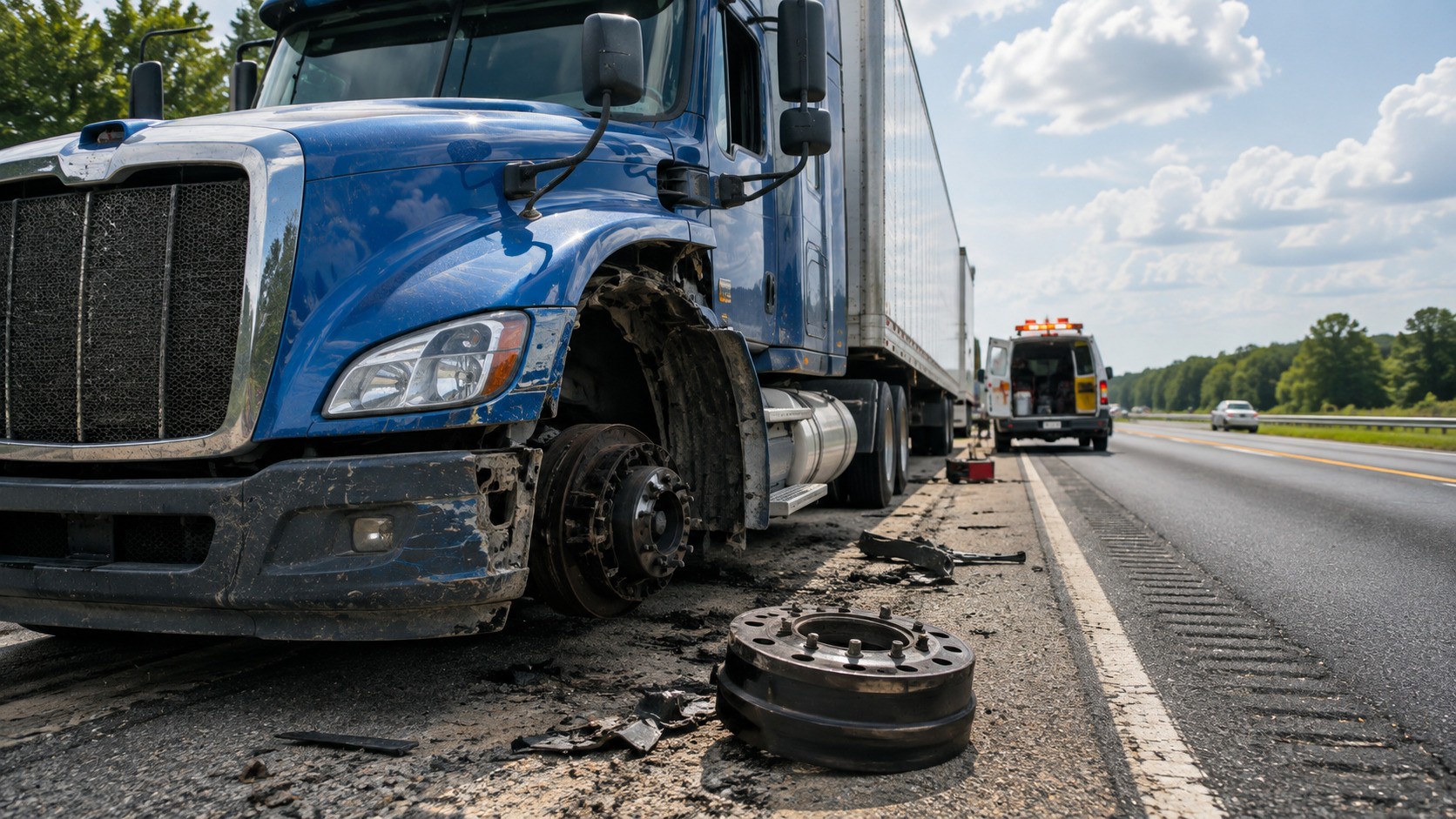
Wheel-off incidents. Improperly torqued lug nuts or damaged wheel studs can cause a wheel to detach at highway speed. A loose truck wheel is a lethal projectile.
Each of these failure modes leaves physical evidence. That evidence becomes the backbone of a claim against the shop that touched the equipment last.
Truck maintenance cases are document-intensive and evidence-driven. Building a strong claim usually involves several categories of proof.
Maintenance and repair records. Federal rules require carriers to keep maintenance records, and reputable shops keep work orders, invoices, and parts records. These documents show what work was performed, when, and by whom. Gaps in the records can be just as telling as the records themselves.
Driver vehicle inspection reports. Drivers must document defects they discover during required inspections. If a driver repeatedly reported a brake problem and the shop signed off on repairs that were never actually made, those reports become critical evidence.
Post-crash vehicle inspections. After a serious wreck, law enforcement and qualified experts can inspect the truck and measure brake adjustment, examine components, and identify pre-existing defects. Preserving the vehicle in its post-crash condition is essential, which is why attorneys send spoliation letters demanding that the tractor, trailer, and all related records be preserved.
Electronic data. Modern trucks record a wealth of information through engine control modules and related systems. Speed, brake application, and fault codes can help reconstruct what happened in the seconds before impact.
Inspection history. Annual inspection certificates and roadside inspection reports reveal whether the vehicle had a history of violations and whether required inspections were actually performed with care.
Expert analysis. Mechanical experts examine failed components to determine whether the failure resulted from poor workmanship, defective parts, deferred maintenance, or something else entirely.
Time matters enormously here. Trucks get repaired, scrapped, or sold. Records get lost. Acting quickly to preserve evidence often makes the difference between a provable case and a dead end.
A truck crash caused by defective maintenance rarely involves a single responsible party. The driver may have ignored warning signs. The motor carrier may have deferred maintenance to save money. A parts manufacturer may have sold a defective component. The maintenance company may have performed careless work. Georgia law provides a framework for sorting out this shared responsibility.
Under OCGA 51-12-33, Georgia juries apportion fault among everyone who contributed to the injury, including parties and, where properly noticed, nonparties. Each defendant is generally responsible for damages in proportion to its own percentage of fault. This apportionment system makes it vital to identify every negligent actor early, because fault assigned to an absent party reduces what the named defendants must pay.
Practically speaking, this means a thorough investigation should examine the driver’s conduct, the carrier’s safety practices, the maintenance provider’s work, and the components themselves. Leaving a culpable party out of the case can shrink the recovery.
Georgia follows a modified comparative negligence rule, also codified in OCGA 51-12-33. An injured plaintiff can recover damages as long as the plaintiff is less than 50 percent responsible for the injury. Any recovery is reduced by the plaintiff’s own percentage of fault. A plaintiff found 50 percent or more at fault recovers nothing.
Defense lawyers in truck cases routinely try to shift blame onto the injured motorist. Careful accident reconstruction and honest evaluation of the facts help counter inflated comparative fault arguments.
Strict time limits apply to these claims. Under OCGA 9-3-33, personal injury lawsuits in Georgia generally must be filed within two years of the date of injury. Wrongful death claims are also generally subject to a two-year period, though certain circumstances can affect the calculation. Property damage claims involving vehicles are generally subject to a four-year limitation period.
Certain situations can pause or alter these deadlines, and claims involving government entities carry special notice requirements with much shorter timeframes. Missing a deadline typically destroys the claim entirely, no matter how strong the evidence. Prompt consultation with an attorney protects against that outcome.
A successful claim against a negligent maintenance company can compensate for the full range of harm Georgia law recognizes. Recoverable damages may include past and future medical expenses, lost wages and diminished earning capacity, pain and suffering, and property damage. In wrongful death cases, Georgia law measures damages by the full value of the life of the deceased. Punitive damages may be available in cases involving willful misconduct or that entire want of care which raises the presumption of conscious indifference to consequences, subject to the requirements and limits of Georgia’s punitive damages statute.
Anyone hurt in a tractor-trailer wreck where mechanical failure may have played a role should consider several steps:
Early legal involvement matters more in truck cases than in almost any other kind of injury claim, because the most important evidence sits in the hands of the trucking company and its vendors.
Yes, a truck maintenance company can absolutely be held liable for a Georgia tractor-trailer crash. When a shop or fleet service provider performs negligent repairs, skips required inspection steps, or certifies a dangerous vehicle as roadworthy, Georgia negligence law and federal safety regulations combine to create a clear path to accountability. These cases demand fast action, careful evidence preservation, and expert mechanical analysis, but the law does not let careless maintenance providers hide behind the driver or the motor carrier.
Injured people deserve a full investigation into every cause of their crash. If defective maintenance played a part, the company responsible for that work belongs in the case. Speaking with an experienced Georgia truck accident attorney is the best way to find out whether a maintenance claim exists and to protect it before critical evidence is lost.
This article provides general information about Georgia and federal law and does not constitute legal advice. Reading it does not create an attorney-client relationship. Consult a licensed Georgia attorney about your specific circumstances.