Contact us
Send Us Your Case Details
We’ll respond and let you know the best way to proceed with your case.

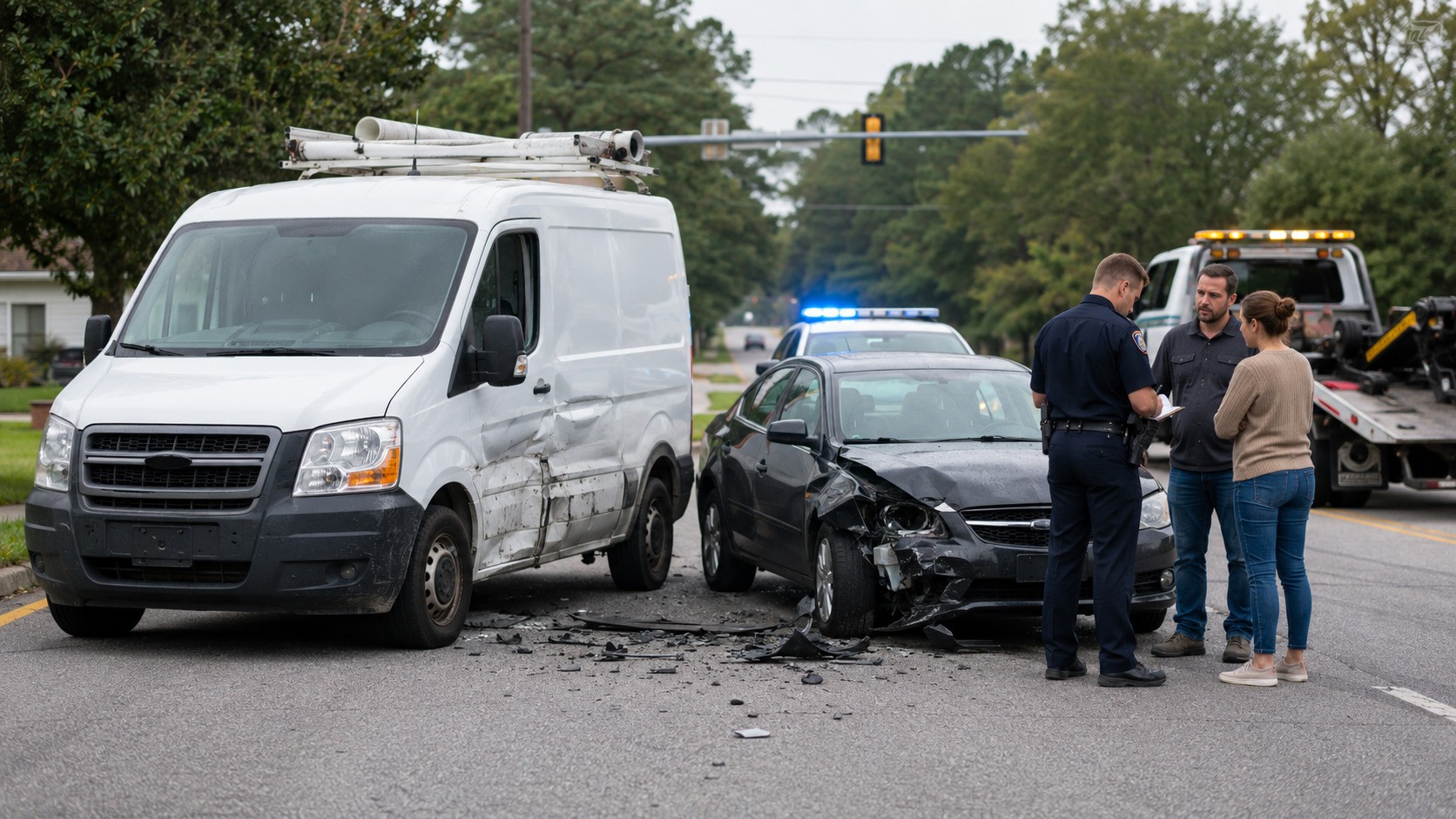
Getting hit by any vehicle is frightening. Being struck by a company vehicle, however, adds layers of complexity that most people never anticipate. Suddenly, you are not just dealing with another driver. You may be dealing with a corporation, a commercial insurance carrier, a team of adjusters, and possibly defense attorneys, all before you have even left the hospital.
The good news? Company vehicle accidents often come with larger insurance policies and more avenues for recovery than a typical car crash. The bad news? The companies behind those vehicles fight harder, move faster, and know exactly how to minimize what they pay you.
This guide walks you through what happens after a company vehicle accident in Georgia, what your rights are, and what steps you should take to protect yourself.
A company vehicle is any vehicle owned, leased, or operated by a business or used by an employee in the course of their job. In Georgia, this covers a wide range of vehicles you see on the road every day, including:
Why does the classification matter so much? Because when a company vehicle hits you, the company itself, not just the driver, may be legally responsible for your injuries. That distinction changes everything about your claim.
Liability in these cases is rarely limited to the person behind the wheel. Georgia law recognizes several theories that can put the employer on the hook.
Under Georgia’s doctrine of respondeat superior, an employer is legally responsible for the negligent acts of its employees committed within the scope of their employment. In plain terms: if a delivery driver runs a red light while making deliveries and hits you, the delivery company is liable for your damages.
The key question is whether the driver was acting “within the scope of employment” at the time of the crash. Courts look at whether the employee was performing job duties, running a work errand, or otherwise serving the employer’s interests. A driver making deliveries on their route is clearly within the scope of employment. A driver who took the company van to a bar on Saturday night probably is not. Even then, though, the company may face other claims.
Georgia also allows injured victims to sue a company directly for its own negligence. If the business hired a driver with a history of DUIs, kept an employee on the road after repeated accidents, or failed to properly train its drivers, the company can be held independently liable. These claims can be powerful because they expose the company’s own conduct, not just the driver’s mistake.
A related theory applies when a company hands the keys to someone it knew or should have known was an incompetent or reckless driver. Entrusting a commercial vehicle to an unqualified person is itself an act of negligence under Georgia law.
Commercial vehicles require regular inspection and upkeep. When brakes fail, tires blow out, or lights stop working because a company skipped maintenance, the business can be liable for the resulting crash. Trucking companies in particular are subject to strict federal maintenance and inspection requirements, and violations can serve as strong evidence of negligence.
Sometimes liability extends even further. A negligent maintenance contractor, a parts manufacturer, or a company that improperly loaded cargo may share responsibility. Identifying every liable party matters because it can mean identifying additional insurance coverage.
Several features set these cases apart, and they cut both ways.
Bigger insurance policies. Georgia requires private drivers to carry only $25,000 per person and $50,000 per accident in bodily injury liability coverage. Commercial policies are typically far larger, often $1 million or more. Federally regulated interstate trucking companies must carry at least $750,000 in liability coverage, and many carry much more. For seriously injured victims, this can be the difference between partial and full compensation.
Faster, more aggressive defense. Trucking and delivery companies often dispatch rapid-response teams to accident scenes within hours. Investigators photograph the scene, interview witnesses, and begin building a defense while you are still in the emergency room. Their insurance adjusters may call you within a day or two, hoping to lock you into a recorded statement or a quick lowball settlement.
More evidence, if you act quickly. Commercial vehicles frequently carry dash cameras, GPS tracking, electronic logging devices, and telematics systems that record speed, braking, and hours of service. Companies also maintain driver personnel files, drug testing records, and maintenance logs. This evidence can make or break your case, but companies are only required to preserve much of it for limited periods. A prompt spoliation letter from an attorney legally obligates the company to preserve this evidence.
Direct action against insurers. In cases involving motor carriers, Georgia’s direct action statutes may allow you to name the trucking company’s insurance carrier directly in your lawsuit. This is a significant advantage unique to commercial carrier cases, because juries can be told that insurance exists to cover the loss.
The steps you take in the first hours and days shape the outcome of your claim.
Call 911 and get medical help. Your health comes first. Even if you feel okay, get evaluated. Adrenaline masks pain, and injuries like concussions, whiplash, and internal bleeding often surface hours or days later. Prompt medical care also creates documentation linking your injuries to the crash.
Get a police report. Always insist that officers respond and file a report. Make sure the report notes that the vehicle was a company vehicle and identifies the business name on the truck or van.
Document everything at the scene. If you are physically able, photograph the vehicles, license plates, company logos and DOT numbers, skid marks, road conditions, traffic signals, and your visible injuries. Get the driver’s name, employer, and insurance information. Collect contact information from every witness.
Do not admit fault or apologize. Even a polite “I’m sorry” can be twisted into an admission. Stick to the facts when speaking with police.
Decline recorded statements from the company’s insurer. You are not required to give the at-fault party’s insurance company a recorded statement, and doing so almost never helps you. Adjusters are trained to extract statements that minimize their payout. Politely decline and refer them to your attorney.
Preserve evidence. Keep damaged clothing, save all medical records and bills, and start a journal documenting your pain, limitations, and missed work.
Contact an attorney quickly. In company vehicle cases, early attorney involvement is not a luxury. It is how critical evidence gets preserved before it disappears.
Georgia is an at-fault state, meaning the party responsible for the crash (and their insurer) pays for the harm caused. To recover, you must prove the driver or company was negligent. That means showing they owed you a duty of care, breached it, and caused your injuries and damages.
Georgia follows a modified comparative negligence rule, codified at O.C.G.A. § 51-12-33. Here is how it works: you can recover damages as long as you are less than 50% at fault for the accident. Your compensation is reduced by your percentage of fault. So if a jury awards $100,000 but finds you 20% responsible, you recover $80,000. If you are found 50% or more at fault, you recover nothing.
Insurance companies know this rule well, and they exploit it. Expect the company’s insurer to argue that you were speeding, distracted, or otherwise contributed to the crash. Every percentage point of fault they shift onto you saves them money. Note also that following Georgia’s 2025 tort reform legislation, evidence of seat belt non-use is now admissible in car accident cases, which defendants may use to argue your damages should be reduced. This is one more reason thorough evidence and skilled advocacy matter.
Victims of company vehicle accidents in Georgia can pursue several categories of damages.
Economic damages cover your measurable financial losses. These include current and future medical expenses, lost wages, diminished earning capacity, rehabilitation and therapy costs, and property damage to your vehicle.
Non-economic damages compensate for the human toll: physical pain and suffering, emotional distress, loss of enjoyment of life, disfigurement, and loss of consortium for your spouse. Georgia does not cap non-economic damages in vehicle accident cases, which means a jury can award what it finds fair based on the severity of your injuries.
Punitive damages may be available in cases involving egregious conduct: a drunk commercial driver, a company that falsified maintenance records, or willful violations of safety regulations. Georgia generally caps punitive damages at $250,000, but that cap does not apply when the defendant acted with specific intent to harm or was impaired by alcohol or drugs.
If a loved one was killed by a company vehicle, Georgia’s wrongful death statute allows surviving family members to recover the “full value of the life of the deceased,” along with a separate estate claim for medical expenses, funeral costs, and the deceased’s pain and suffering before death.
Timing is critical. Under O.C.G.A. § 9-3-33, you generally have two years from the date of the accident to file a personal injury lawsuit in Georgia. Property damage claims carry a four-year deadline. Miss the deadline, and your claim is almost certainly barred forever, no matter how strong it is.
Government vehicles come with much shorter fuses. If you were hit by a city, county, or state vehicle, Georgia law requires you to serve a formal written notice of your claim, called an ante litem notice, before you can sue:
These notice requirements are unforgiving. Courts routinely dismiss otherwise valid claims because the notice was late, sent to the wrong official, or missing required information. If a government vehicle was involved in your crash, speak with an attorney immediately.
Companies frequently argue that their drivers are independent contractors rather than employees, hoping to escape vicarious liability. This defense is common in cases involving delivery services, rideshare drivers, and owner-operator truckers.
The label a company puts on its workers is not the end of the story. Georgia courts look at the actual relationship, particularly how much control the company exercises over the driver’s work. Federal regulations also treat drivers operating under a motor carrier’s authority as statutory employees for liability purposes in many trucking cases. Additionally, rideshare companies operating in Georgia must carry $1 million in liability coverage while a driver is transporting a passenger or en route to a pickup. An experienced attorney can cut through the contractor smokescreen and identify every available source of recovery.
Most company vehicle claims follow a familiar arc. First comes the investigation phase: gathering the police report, medical records, vehicle data, company records, and witness statements. Next, once you have finished treatment or reached maximum medical improvement, your attorney sends a demand package to the insurer outlining liability and damages. Negotiation follows, and many cases settle at this stage.
When insurers refuse to offer fair value, filing a lawsuit is the next step. Litigation opens the door to discovery, including depositions of the driver and company representatives, document production, and expert analysis, which often increases settlement pressure. Only a small percentage of cases go all the way to trial, but preparing every case as if it will is what drives fair settlements.
Beware of early settlement offers. Companies know that injured people facing medical bills and missed paychecks are vulnerable. A quick check may sound tempting, but once you sign a release, your claim is over, even if your injuries turn out to be far worse than you thought.
Corporations and their insurers handle thousands of claims. They have investigators, adjusters, and defense lawyers whose job is to pay you as little as possible. Going up against that machinery without representation puts you at a serious disadvantage.
An experienced Georgia personal injury attorney levels the field by preserving time-sensitive evidence, identifying every liable party and insurance policy, calculating the true long-term value of your damages, handling all communication with insurers, and taking the case to trial when necessary. Most personal injury attorneys, including our firm, work on a contingency fee basis. You pay nothing unless we recover money for you.
If you or a loved one has been hit by a company vehicle in Georgia, the clock is already running on evidence, on deadlines, and on your opportunity to build the strongest possible case. Contact Eric Sterling Law Firm today for a free consultation. We will review your case, explain your options, and fight to get you the full compensation you deserve.
Disclaimer: This blog post is provided for general informational purposes only and does not constitute legal advice. Reading this article does not create an attorney-client relationship with Eric Sterling Law Firm. Laws change, and the application of the law depends on the specific facts of each case. If you have been injured in an accident, consult a licensed Georgia attorney about your particular situation as soon as possible.