Contact us
Send Us Your Case Details
We’ll respond and let you know the best way to proceed with your case.


The biggest sporting event on the planet is about to land in our backyard. Between June 15 and July 15, 2026, Atlanta will host eight FIFA World Cup matches at Mercedes-Benz Stadium, including a semifinal that will be one of only two played anywhere in the world that month. The city is expecting roughly half a million visitors, and a good portion of them will be behind the wheel of a car they have never driven through Atlanta before.
If you live, work, or commute anywhere inside the Perimeter, your drive is about to change. If you are a fan coming in for a match, the way you approach the stadium will determine whether your day starts with anticipation or with brake lights and stress. Either way, the laws of the State of Georgia apply to you the moment your tires hit pavement here. Knowing those rules, and knowing what to do if something goes wrong, can protect your safety, your wallet, and your legal rights.
Here is what every driver should know before the World Cup arrives.
Mercedes-Benz Stadium (which FIFA will refer to as Atlanta Stadium during the tournament due to sponsorship rules) is scheduled to host five group-stage matches, a Round of 32 match, a Round of 16 match, and a semifinal. The group-stage dates are June 15, June 18, June 21, June 24, and June 27. The knockout rounds fall on July 1 and July 7, and the semifinal takes place on July 15.
Confirmed group-stage matchups include Spain versus Cabo Verde on June 15, South Africa playing on June 18, Spain versus Saudi Arabia on June 21, Morocco versus Haiti on June 24, and Uzbekistan playing on June 27. The bracket teams for the knockout rounds depend on group-stage results, but those dates are locked in.
Kickoff times vary. Several matches start at noon Eastern, while later-round matches kick off at 3 p.m. Eastern. A noon kickoff means peak arrival traffic between roughly 9 a.m. and 11:30 a.m., which collides directly with the tail end of weekday rush hour. The Atlanta Convention and Visitors Bureau and city transportation officials have stated that very few roads will actually be closed, but restricted zones will exist around the perimeter of the stadium and around Centennial Olympic Park, where the official FIFA Fan Festival is taking place from June 12 through July 15.
That fan festival is important to know about even if you have no interest in soccer. Centennial Olympic Park sits less than a 10-minute walk from Mercedes-Benz Stadium, and the festival will draw large crowds on non-match days as well. Pedestrian traffic downtown will spike for more than a month straight.
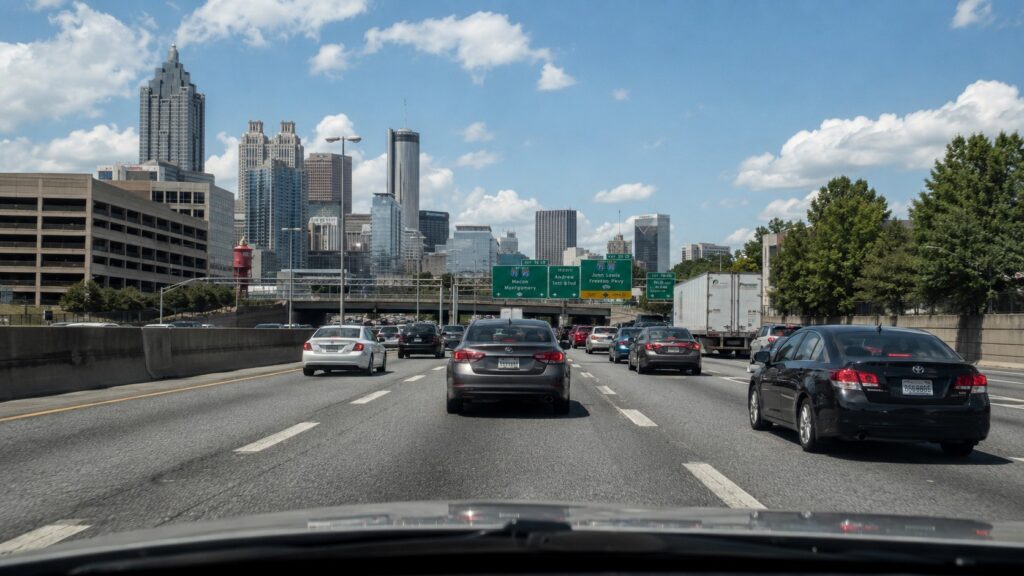
Anyone who has merged onto the Downtown Connector at 5 p.m. on a Tuesday already knows Atlanta has a traffic problem. The Connector, where I-75 and I-85 combine through Downtown and Midtown, is one of the most congested stretches of interstate in the Southeast. I-285, GA-400, and I-20 do not offer easy escapes either, especially at the interchanges known to locals as Spaghetti Junction (I-285 and I-85 North) and the I-75 and I-285 junction near Cumberland.
Rush hour in Atlanta typically runs from about 6:30 a.m. to 9 a.m. and from roughly 3:30 p.m. to 7 p.m. on weekdays. According to the National Safety Council, the late afternoon window from 4 p.m. to 7:59 p.m. is also the peak time of day for fatal and nonfatal crashes nationwide. That window stretches later in summer because more people are out after work, on vacation, or attending events.
Now add tens of thousands of additional fans driving toward downtown for a noon or 6 p.m. World Cup kickoff, plus rental cars, charter buses, rideshare vehicles, and pedestrians flooding crosswalks. Traffic clogs I-75, I-85, I-20, and the surface streets feeding the stadium starting roughly 90 minutes before any major event at Mercedes-Benz Stadium. After the final whistle, expect 45 to 60 minutes just to exit parking and merge back onto an interstate.
For matches in June and July, plan to arrive at least two hours before kickoff if you are driving. Three hours is not unreasonable for the semifinal on July 15.
This is going to sound strange in the most car-dependent metro in the South, but the smartest move for most fans heading to the stadium is to leave the car at home or at a park-and-ride lot.
MARTA, Atlanta’s rapid transit system, was practically built for moves like this. The Vine City station on the Blue and Green Lines is about a two-minute walk from the Mercedes-Benz Stadium gates. The GWCC/CNN Center station (recently renamed SEC District Station) is also walking distance from the stadium and Centennial Olympic Park. Note that the west entrance of the SEC District Station has been closed through portions of 2026 for construction, so you may need to use the east entrance on Spring Street.
Park-and-ride options at outer MARTA stations let you skip downtown driving entirely. North Springs, Dunwoody, Doraville, Indian Creek, College Park, and others offer parking for daily use, and most of them connect by a single transfer at Five Points to reach the stadium area. A round-trip MARTA fare costs a fraction of stadium-area parking, which can run anywhere from $25 to $60 or more per event.
If you must drive to the stadium itself, official parking is cashless and digital through ParkHub. You must pre-purchase a pass. If you show up without a digital QR code, you will be turned away from every official lot. Bring a portable phone charger so a dead battery does not strand your parking access.
Rideshare drop-offs typically use the GWCC Bus Lane C area. After the match, walk a few blocks away from the stadium before requesting your ride. Surge pricing and pickup chaos near the gates can easily double or triple your fare and add 30 minutes to your wait.
If you are driving into Atlanta from out of state for the World Cup, this is the single most important Georgia law to memorize: you cannot hold your phone while driving. Period.
Georgia’s Hands-Free Law (O.C.G.A. § 40-6-241) took effect on July 1, 2018. You cannot hold a phone in your hand, prop it against your shoulder, or use any part of your body to support it. You cannot read, write, or send texts, emails, or social media posts. You cannot watch videos, with the limited exception of navigation apps and dash cameras. Recording video is prohibited.
You are allowed to make and receive calls using speakerphone, Bluetooth, an earpiece, a wireless headphone, or a connected car system. You can glance at a mounted GPS screen as long as you do not have to touch it. You can use voice commands. You can use your phone freely if you are lawfully parked, but stopping at a red light does not count as parked. A driver in the next lane on Northside Drive who taps out a quick text while waiting at a light is breaking the law.
Penalties escalate fast. A first offense brings a $50 fine and one point on your license. A second offense within 24 months is $100 and two points. A third or subsequent offense is $150 and three points. Drivers under 18 face stricter limits, and commercial drivers (which includes most charter bus operators bringing fans into town) have additional restrictions.
Beyond the ticket, holding a phone matters in personal injury cases. If you cause an accident while holding your phone, the other driver’s attorney can subpoena your phone records to prove it. That evidence can establish negligence and, in some cases, support a claim for punitive damages. The same applies in reverse: if you are hit by a driver who was on their phone, those records can be powerful evidence in your favor.
Five group-stage matches start at noon. Three matches start in the late afternoon or evening. The Fan Festival at Centennial Olympic Park will be serving alcohol throughout the day. After eight to ten hours of pregaming, watch parties, and tailgating, a lot of people will be making decisions about whether they are okay to drive home.
Do not make a bad one.
Georgia’s legal blood alcohol concentration limit is 0.08 percent for drivers 21 and over. For commercial drivers, the limit is 0.04 percent. For drivers under 21, Georgia enforces a zero-tolerance limit of 0.02 percent. Penalties for a first DUI conviction in Georgia include fines of $300 to $1,000, up to one year in jail (although first offenders often avoid jail), license suspension, at least 40 hours of community service, and mandatory completion of a DUI Risk Reduction Program. A BAC of 0.15 percent or higher triggers enhanced penalties on the first offense, including a longer license suspension and the same sentencing structure as a second DUI.
If alcohol or drug impairment contributes to an accident that causes serious injury, you can face felony charges under O.C.G.A. § 40-6-394. A fatality involving an impaired driver is first-degree vehicular homicide, which carries three to 15 years in prison and a fine of up to $100,000.
Georgia DUI convictions cannot be expunged. They remain on your record permanently.
Atlanta Police, the Georgia State Patrol, and surrounding county agencies have already announced enhanced enforcement plans for the World Cup window. Sobriety checkpoints are legal in Georgia and will likely appear near downtown after evening matches. The cost of a rideshare home, even at surge pricing, is a small fraction of what a DUI will cost you.
Georgia has a unique penalty for excessive speeding. Under the Super Speeder Law (O.C.G.A. § 40-6-189), driving 75 mph or more on a two-lane road, or 85 mph or more on any road or highway in the state, triggers an additional $200 fine on top of whatever penalty the original ticket carries.
Visitors from other states often assume that flowing with interstate traffic protects them. It does not. The Super Speeder fine applies regardless of how fast everyone else around you was going.
Georgia’s “Steer It, Clear It” rule requires drivers in a minor accident to move their vehicles out of the travel lanes if the vehicles are still operable, no one is seriously injured, and it is safe to do so. The purpose is to prevent the secondary crashes that frequently occur when traffic stacks up behind a stopped vehicle on a busy highway. Failing to move can result in a citation.
That said, do not move your vehicle if anyone is hurt, if your car is too damaged to drive, or if doing so would put you in danger. Safety always comes before clearing the lane.
If a crash happens, what you do in the first hour can dramatically affect your case if injuries are involved. The basic steps are the same whether you are a local commuter or a fan visiting from Madrid.
First, check yourself and your passengers for injuries. If anyone is hurt or might be hurt, call 911 immediately. Even minor symptoms like neck stiffness, headache, or confusion can be signs of a serious injury that gets worse over the next 24 to 48 hours. Adrenaline masks pain. Get checked.
Second, if it is safe and your vehicle is drivable, move it out of the lane of travel under the Steer It, Clear It rule. Turn on your hazards. Set out flares or warning triangles if you have them.
Third, call the police. Under O.C.G.A. § 40-6-273, you must report any accident involving injury, death, or apparent property damage of $500 or more. In a brand-new compact car, that threshold is hit with a broken taillight. The responding officer will create a Georgia Uniform Motor Vehicle Accident Report, which is the document insurance adjusters and attorneys rely on as the official record of what happened. If the police are unable to respond, you are required to file a self-report (Form SR-13) with the Georgia Department of Transportation.
Fourth, exchange information with the other driver. Georgia law (O.C.G.A. § 40-6-270) requires drivers to exchange names, addresses, driver’s license numbers, vehicle registration information, and insurance details. Photograph their driver’s license, insurance card, and license plate. Handwritten exchanges are full of errors. Photos are not.
Fifth, document everything. Photograph the position of the vehicles before they are moved if possible. Take pictures of damage from multiple angles, of skid marks, of debris, of traffic signs, of weather and road conditions, and of any visible injuries. Get the names and phone numbers of witnesses. A neutral third party’s statement is worth more than a thousand arguments about who had the green light.
Sixth, be careful what you say. Do not admit fault, even casually. Do not say “I’m sorry,” even out of basic politeness. Insurance adjusters interpret that as an admission. Speak factually with the police, answer their questions honestly, and stop there. Statements made at the scene can be used against you later in a way the police report itself cannot be.
Seventh, get medical attention even if you feel okay. Soft-tissue injuries, concussions, and internal injuries can take hours or days to fully present. A medical record created shortly after the accident is some of the most important evidence you can have. Insurance companies routinely deny claims by arguing that a delay in treatment proves the injury was not serious or was caused by something else.
Eighth, notify your insurance company. Keep the description factual and brief. Do not speculate about fault, speeds, or what the other driver was doing. If you were injured reach out personal injury lawyer.
Leaving the scene of an accident is a serious crime in Georgia. Under O.C.G.A. § 40-6-270, leaving a scene where someone was seriously injured or killed is a felony punishable by one to five years in prison. Even leaving a fender-bender with no injuries can lead to fines of up to $1,000, up to 12 months in jail, and three points on your license.
Georgia is an at-fault state. The driver responsible for causing the crash (and their insurance company) pays for the damages. Georgia also follows a modified comparative negligence rule. If you are found to be 50 percent or more at fault, you cannot recover anything from the other driver. If you are less than 50 percent at fault, your recovery is reduced by your percentage of fault.
The minimum required auto insurance in Georgia is $25,000 in bodily injury liability per person, $50,000 per accident, and $25,000 in property damage liability. Those minimums sound like a lot until you see a single emergency room bill. A serious injury easily exceeds $25,000 in medical costs alone.
This is why uninsured and underinsured motorist (UM/UIM) coverage matters so much in Atlanta. The metro area has a significant number of uninsured drivers, and a single visit to Grady Memorial Hospital can blow through a minimum policy in an afternoon. UM/UIM coverage on your own policy steps in when the other driver does not have enough insurance to cover your losses, or when a hit-and-run leaves you with no other driver to pursue. If you are renewing your policy before the World Cup, take a hard look at your UM limits.
You have two years from the date of the accident to file a personal injury lawsuit in Georgia, and four years to file a property damage claim. Government vehicles, commercial trucks, and dram shop claims can have shorter or different timelines, which is one reason to talk to a lawyer sooner rather than later if you have been hurt.
The World Cup is going to be one of the most memorable summers Atlanta has ever had. It will also be one of the most challenging months to be on Georgia roads in a long time. The combination of unfamiliar drivers, late-night events, alcohol, summer heat, and unpredictable traffic patterns is a recipe for crashes. The drivers who plan ahead, leave early, use MARTA when possible, stay off their phones, and never drive impaired will get home safely. The drivers who do not will be making phone calls from the side of the road or worse.
If the worst happens and you or someone you love is hurt in a crash during the tournament, do not handle it alone. Insurance companies move quickly after an accident, and the things they ask you to sign in the first week often work against you. An experienced Georgia personal injury attorney can talk to the adjusters, preserve evidence before it disappears, deal with medical liens, and make sure the deadlines under Georgia law are met.
Drive smart. Cheer loud. Get home safe. The world is coming to Atlanta, and we want every visitor and every neighbor to be here to celebrate when it leaves.